1.7 The Bergman Cyclisation Reaction
1.7.1. Introduction
The enediynes can be synthesized via Sonogashira coupling protocol. The enediynes undergoes a key cycloaromatization reaction which is the heart at the chemistry of enediyne molecules. The Bergman cyclization or Bergman reaction or Bergman cycloaromatization is an organic reaction and more specifically a rearrangement reaction taking place when an enediyne is heated in presence of a suitable hydrogen donor (Scheme 12). It is named for the American chemist Robert George Bergman. The reaction product is a derivative of benzene.
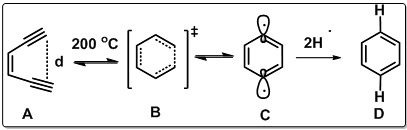 |
Scheme 12. Bergman cyclization or cycloaromatization |
The Cope rearrangement of hex-3-ene-1,5-diyne (A), which results in concerted cyclization via transition state B to p-benzyne (C), was first reported by Bergman in 1972, and has become known as the Bergman cyclization. Included in Bergman’s report were instances of intra- and intermolecular trapping of p-benzynes to give “cycloaromatized” products (D, Scheme 12).
Masamune et al. had described the conversion of cyclic enediynes into the benzenoid systems (Scheme 13), prior to the studies by Bergman. When the enyne moiety is incorporated into a 10-membered hydrocarbon ring (e.g. cyclodeca-3-ene-1,5-diyne in Scheme 13) the reaction, taking advantage of increased ring strain in the reactant, is possible at the much lower temperature of 37°C. However, the involvement of a diradical species was not mentioned in this paper.
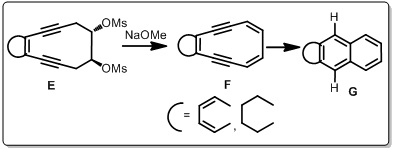 |
Scheme 13. Observation by Masamune et al. (1971). |
In 1980, Wong and Sondheimer observed a cycloaromatization from in situ generated cyclic enediynes e.g. (K) and postulated the intermediacy of a 1,4-diradical (Scheme 14).
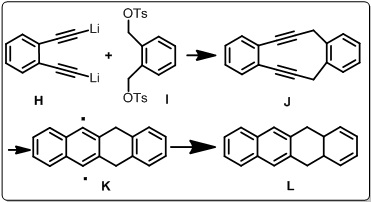 |
Scheme 14. Pioneering work by Wong and Sondheimer (1980) |