9.1.3 Reaction of Allyl Cyanide
The asymmetric hydroformylation of allyl cyanide is of great interest because the iso-aldehyde derivative can be converted into 2-methyl-4-butanol, which is intermediate, for the asymmetric synthesis of tachikinin, a novel NK1 receptor agonist (Scheme 7). The reaction has been studied using diphosphite, phosphine-phosphite, bis-phosphacyclic and phosphoroamidite ligands with up to 96% ee.
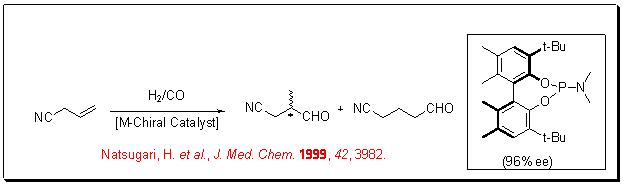
Scheme 7
9.1.4 Reaction of Heterocyclic Alkenes
Few studies are focused on the hydroformylation of heterocyclic alkenes. For these substrates, the regioselectivity is of special interest because it is different from that of the acyclic alkenes. For example, the hydroformylation of 2,5-dihydrofuran can lead to the formation of both the tetrahydrofuran-3-carbaldehyde A (expected product) and tetrahydrofuran-2-carbaldehyde B (could be formed via an isomerization process). The regioselectivity is to be controlled by the modification of the ligands and reaction conditions.
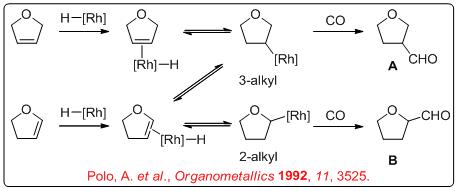
Scheme 8