Carbonylation of the unsaturated substrates using transition metal catalysis provides powerful tool to produce fine chemical intermediates. The asymmetric carbonylation is among the most challenging homogeneous process and their potential is yet to be made. The Rh-catalyzed hydroformylation of alkenes together with the Pd-catalyzed hydroxy and alkoxycarbonylation of alkenes are the most famous examples for the asymmetric carbonylation reactions. The important difference between these reactions is the Rh-catalyzed hydroformylation is of greater industrial interest than the palladium based carbonylation process.
9.1 Hydroformylation Reaction
The conversion of alkenes to aldehydes is the largest volume homogeneous transition metal-catalyzed reaction. This process has been extensively explored and a number of methods and catalysts have been developed to control the regioselectivity in internal and terminal aldehydes (Scheme 1).
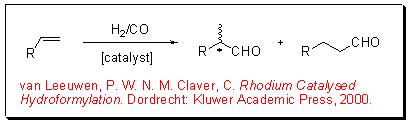
Scheme 1
9.1.1 Reaction of Vinyl Arenes
The asymmetric hydroformylation of vinyl arenes is an attractive route to afford optically active aldehydes, which are substrate precursors for the synthesis of high-value pharmaceuticals, agrochemicals, biodegradeful polymers and liquid crystals (Scheme 2). Since the beginning of 1970, chiral Rh-diphosphine complexes have been used as catalysts for this transformation with moderate enantioselectivity (below 60%). From beginning of 1990, the use of bisphophacyclic ligands, diphosphites and phosphine-phosphite, has emerged as alternative for this reaction. Scheme 3 summarizes some of the new diphosphite ligands developed with biaryl, spiro, pyranoside, mannitol and macrocyclic backbones for the asymmetric hydroformylation of vinyl arenes with low to moderate success (ee's from 16% to 76%).
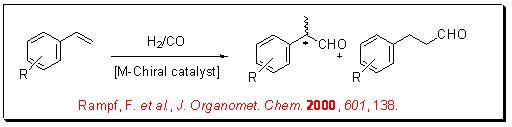
Scheme 2
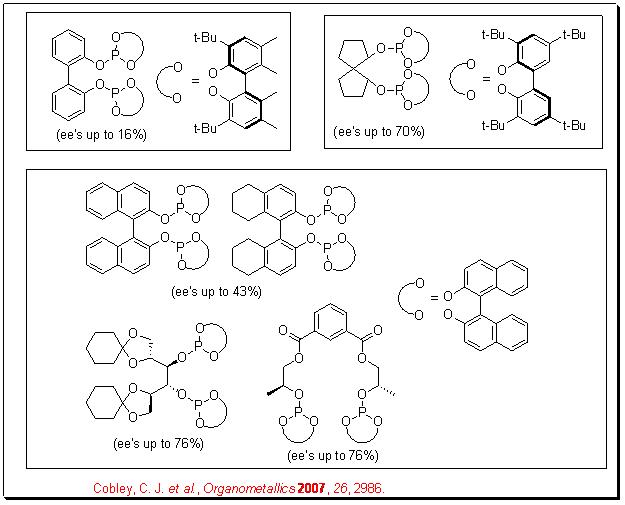
Scheme 3. Diphosphite Ligands for Hydroformylation