5.4.5 Organocatalysis
Remarkable progress has been made on the asymmetric epoxidation of alkenes using organo catalysis. Chiral ketones are among the some of the most developed epoxidation catalysts. Active dioxirane is generated from ketone and oxone (potassium peroxomonosulfate) or hydrogen peroxide under milder reaction conditions. Among the many useful chiral ketones reported, fructose derived ketone developed by Shi group is the most reliable catalyst with respect to high enantioselectivity and broad substrate scope (Scheme 9).
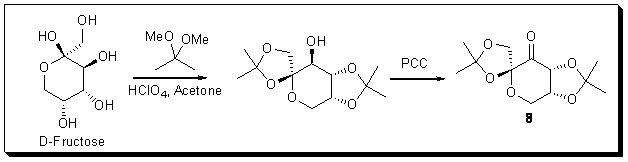
Scheme 9
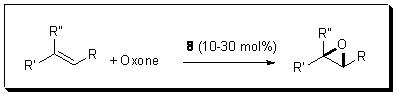
For example, in presence of 8 (typically 20-30 mol%), a variety of trisubstituted alkenes proceed reaction with excellent enantioselectivity (Scheme 10).
Examples:
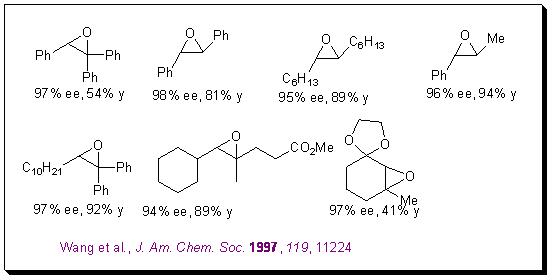
Scheme 10
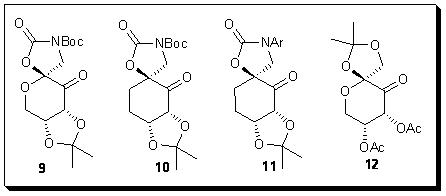
In case of cis and terminal alkenes, the glucose-derived ketone 9 with N -Boc oxazolidinone provides high enantioselectivity. A carbocyclic analogue 10 and N -aryl substituted variants 11 have also been introduced for the epoxidation of styrene derivatives and cis -disubstituted alkenes. Furthermore, the chiral ketone 12 with electron-withdrawing acetate has been found to catalyze the epoxidation of α,β -unsaturated ester with high enantioselectivies.