5.4.2 Ruthenium-Catalyzed Aerobic Epoxidation
Chiral Ru(NO)-salen complexes has been found to catalyze the aerobic epoxidation of alkenes in presence of water under visible light irradiation at room temperature (Scheme 1). This method is attractive from environmental and economic standpoint. The observed preliminary experimental results suggest that an aqua ligand coordinated with the ruthenium ion acts as a proton transfer agent for the oxygen activation process.
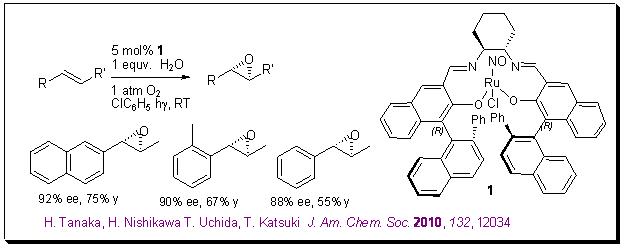
Scheme 1
5.4.3 Titanium-Catalyzed Epoxidation with Hydrogen Peroxides
The use of Ti(salan) for the epoxidation of alkenes has been demonstrated in the presence of aqueous H2O2. The reaction is stereospecific and decomposition of H2O2 has not been observed. The most striking feature of this system is aliphatic alkenes that are one of the most challenging substrates for asymmetric epoxidation can be successfully oxidized with high enantioselectivity (Scheme 2). Furthermore, the in situ generated titanium complex derived from 3 (SALANEL) and Ti(OiPr)4 in CH2 Cl2 catalyzes the epoxidation of alkenes in the presence of phosphate buffer with excellent enantioselectivity (Scheme 3).
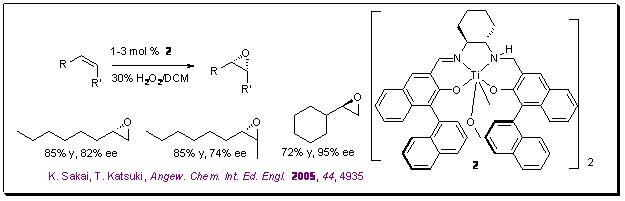
Scheme 2
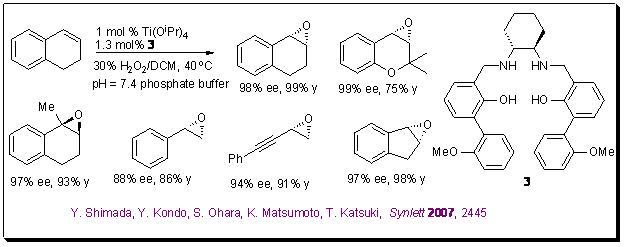
This epoxidation protocol has been successfully applied to a multigram scale synthesis of indene oxide