In this protocol, the μ-oxo dimer dissociates into a monomeric species that catalyzes the reaction (Scheme 11). Moreover, monomeric Nb(salan) complexes prepared in situ from Nb(OiPr)5 and salan ligands followed by water treatment are found to catalyze the epoxidation better using aq. H2O2 with enantioselectivity ranging from 83 to 95% ee. This is the first example of the enantioselective epoxidation of allylic alcohols using aq. H2O2 as terminal oxidant.
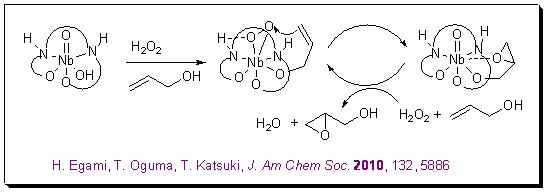
Scheme 11
5.4 Epoxidation of Unfunctionalized Alkenes
Asymmetric epoxidation of unfunctionalized alkenes affords an appealing strategy for the synthesis optically active organic compounds. This section covers some of the recent developments on this protocol.
5.4.1 Manganese-Catalyzed Reactions
In 1990, Jacoben and Katsuki groups independently reported the chiral Mn-catalzyed asymmetric epoxidation of unfunctionalized alkenes. The catalysts can readily be synthesized by the reaction of Mn(OAc)2 with Schiff base derived from chiral 1,2-diamines and 2-hydroxybenzaldehyde derivatives (Scheme 12). Reaction with Mn(OAc)2 in the presence of air gives the Mn(III) complex that may be isolated as the chloro derivative after the addition of lithium chloride.
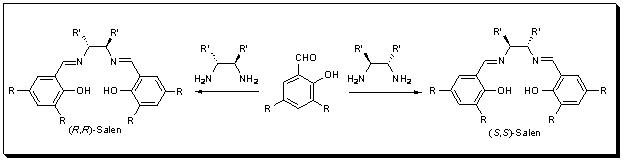
Scheme 12
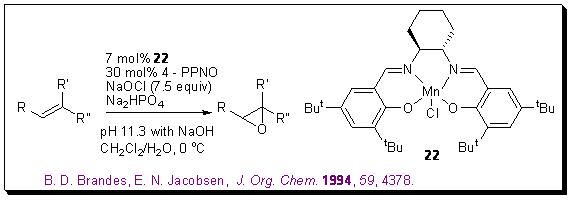
For example, chiral Mn-salen 22 catalyzes the epoxidation of trisubstituted unfunctionalized alkenes with 88-95% ee (Scheme 13).
Examples:
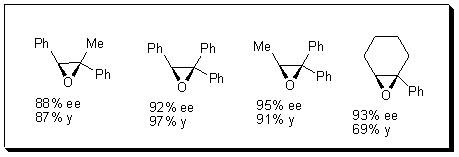
Scheme 13