5.3 Epoxidation of Allylic Alcohols
Epoxidation of allylic alcohols is a well developed practical process in asymmetric catalysis.
5.3.1 Titanium-Catalyzed Epoxidation
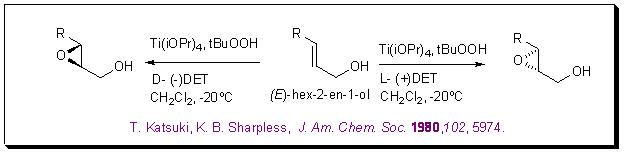
The Sharpless asymmetric epoxidation of allylic alcohol provides a powerful tool for the synthesis of optically active epoxy alcohol. For example, hexe-2-en-1-ol undergoes epoxidation to give chiral epoxy alcohols with 94% ee and 85% yield in presence of 5-10 mol% of Ti(OiPr)4 , L-(+)-DET and t -BuOOH (Scheme 1). Using D-(-)-DET as chiral source the opposite enantiomer can be obtained with similar yield and enantioselectivity.
Examples:

Scheme 1
In case the substrates having more double bonds, the allylic double bond can be oxidized. For example, the allylic double bond of geraniol can be selectively oxidized with 95% ee (Scheme 2).
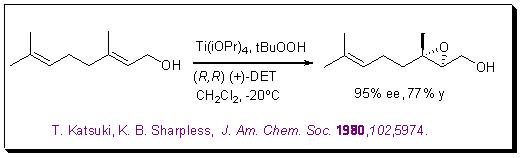
Scheme 2
Mechanism
The reaction of titanium alkoxide with tartrate ligands leads to the formation of the dimers 1 and 4 that in the presence of t -BuOOH are converted into the intermediates 2 and 5, respectively, by displacement of the isopropoxide and tartrate carbonyl groups (Scheme 3-4). Reaction of 2 and 5 with allylic alcohol give the intermediates 3 and 6, respectively. The stereochemistry of the epoxide is determined by the diastereomer of the chiral tartrate diester.
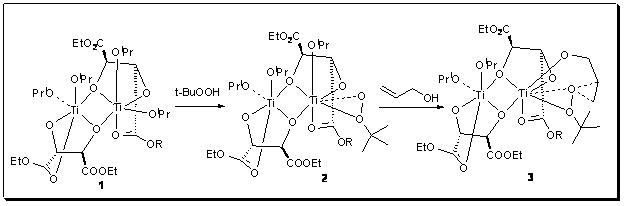
Scheme 3
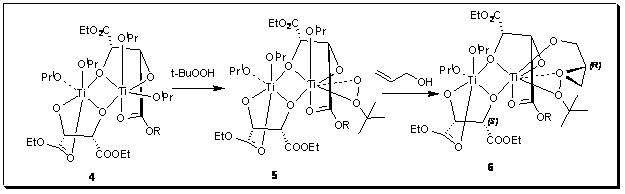
Scheme 4