Functionalization of C-H bonds constitutes an attractive approach for the direct synthesis of complex organic molecules such as pharmaceuticals, natural products, and other industrially relevant targets. Thus, much effort has been devoted to achieve practical, catalytic and selective methods for the C-H functionalization. Scheme 1 presents the two major directions evolved for the C-H functionalization process: (i) direct C-H activation involving oxidative addition to the C-H bond onto an active metal center, and (ii) insertion of transition metal-coordinated carbenes or nitrenes into the C-H bond to give functionalized products.
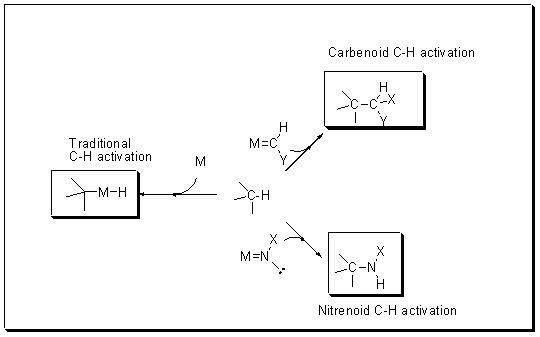
Scheme 1. Modes of C-H Activation
3.1 Reactions with Metal Carbenoid
Metal carbenes generally produced from diazo compound by metal-catalyzed nitrogen extrusion. Alternative carbene precursors include iodonium, sulfonium, sulfoxonium, thiophenium and phosphonium ylides, but their synthetic application is less explored. The general mechanism for the generation of carbene via dirhodium complexes is shown in Scheme 2. In the presence of suitable metal complex, the diazo compound can coordinate reversibly and undergo rate limiting extrusion of nitrogen to give reactive metal carbenoid intermediate. The latter will react with a suitable trapping agent present in the reaction mixture.
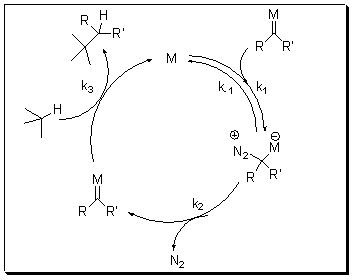
Scheme 2. Carbenoid C-H Insertion