A dynamic kinetic resolution with enzymatic aminolysis provides effective route towards the access of enantiomerically enriched acids. For example, in the presence of an immobilized phosphonium chloride for racemization of ethyl 2-chloropropionate and lipase, aminolysis can be carried out to give amides with up to 92% yield and 86% ee (Scheme 6).
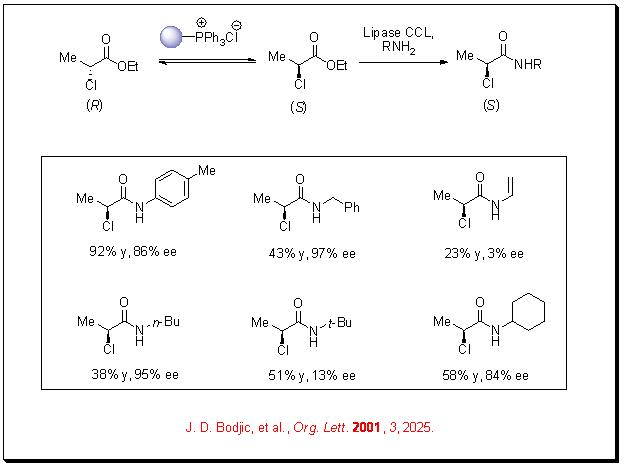
Scheme 6
11.2 Hydrolytic Reactions
The enzymatic hydrolysis of racemic esters, amides, nitriles and epoxides affords effective methods for the synthesis of optically pure carboxylic acids, amines, amides, esters and alcohols. The reactions of a broad range of substrates have been well explored.
11.2.1 Ester Hydrolysis
Hydrolysis of racemic or prochiral ester using enzymes such as lipase, esterase and protease provides effective method for the resolution of broad range of substrates. Recently, the hydrolysis of indole ethyl ester has been shown using a lipase from Pseudomonas fluoresens (Scheme 7). The process runs at a high substrate concentrate 100g/L and turned out to be technically feasible to perform successfully on a 40-kg scale.
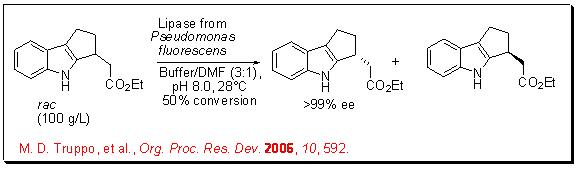
Scheme 7