Biocatalysis is a highly efficient and a powerful tool for organic chemists to prepare optically pure molecules. A broad range of biocatalytic methods has been already in use for large-scale manufacture of drug intermediates. This module covers some of the recent developments in the enzyme catalysis.
11.1 Acylation of Alcohols and Amines
The enzymatic resolution of alcohols and amines affords an effective method to access optically active alcohols and amines from racemic or prochiral substrates.
11.1.1 Reactions with Alcohols
The use of lipase for the resolution of racemic alcohols is a widely known technology. However, this method gives the product with maximum up to 50% yield. This limitation can be overcome by coupling the lipase-catalyzed enantioselective resolution with a racemization of the alcohol substrate, thus obtaining a dynamic kinetic resolution process. The latter process can be pursued employing a nonchiral metal complex as a catalyst. For example, using the combination of Ru complex and CAL-B, the acylation of racemic alcohol can be accomplished with 78-92% yield and 99% ee (Scheme 1).
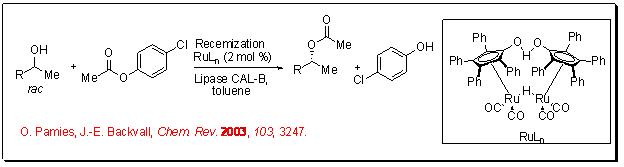
Scheme 1
This methodology has been subsequently utilized for the enantio- and diastereoselective synthesis of chiral polymers. For example, dimethyl adipate reacts with a mixture of racemic and meso -alcohols to give chiral polyester (Scheme 2). Ru complex acts as a racemization catalyst in combination with lipase CAL-B as biocatalyst for the resolution.
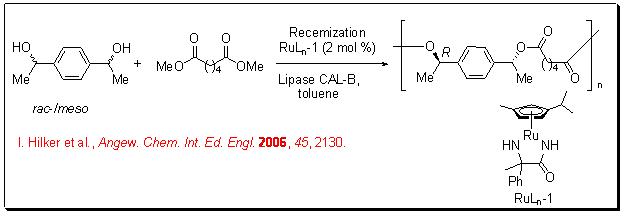
Scheme 2
Furthermore, the transformation has been demonstrated employing a cheap and readily available aluminium complex prepared from AlMe3 and BINOL as the racemization catalyst. For example, racemic 1-phenyl-1-propanol can be acylated with 99% yield and 98% ee (Scheme 3).
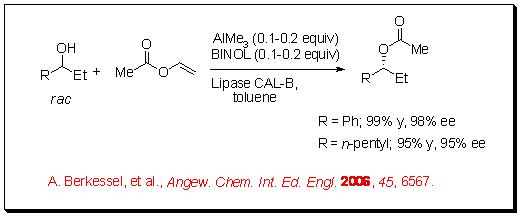
Scheme 3