5.5.2.2 Selenium Dioxide
Selenium dioxide (SeO2 ) is useful for the oxidation of allylic and benzylic C-H bonds to give alcohols or ketones (Scheme 5). The order of ease of oxidation is CH2> CH3> CH. The oxidation takes place at the more substituted end of the double bond.
| W. J. Hoekstra, Encyclopedia of Reagents for Organic Synthesis, John Wiley and Sons, Inc., L. A. Paquette, Ed., New York, 1995, 6 , 4437. |
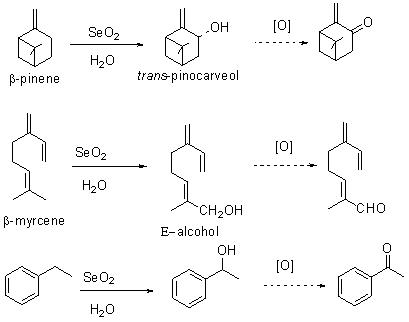
Scheme 5
Mechanism
The reaction takes place via ene reaction. In the absence of hydrolysis, alkenes can be converted into carbonyl compounds (Scheme 6).
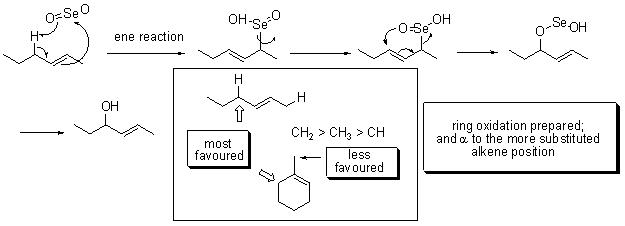
Scheme 6
SeO2 oxidizes alkynes into 1,2-dicarbonyl compounds in the presence of small amount of H2 SO4 with high yield (Scheme 7).
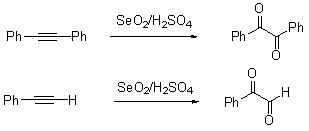
Scheme 7
SeO2 is useful reagent for the oxidation of methyl or methylene group adjacent to the carbonyl group to give 1,2-dicarbonyl compounds (Scheme 8). The reaction is called Riley oxidation.
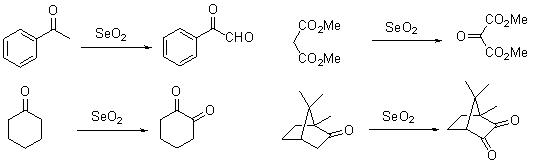
The reaction takes place via the intermediate β -ketoseleninic acid.

Scheme 8