5.5.2 Selenium Compounds
The study of organoselenium compounds has received considerable attention because of their interesting properties. In this section, we will cover some of the important applications of Se and SeO2 in organic synthesis.
5.5.2.1 Selenium
Selenium reacts with organolithium, -sodium and -magnesium to provide metal selenolates that afford selenides by the reaction with electrophiles (Scheme 1), diselenides by oxidation, and selenols by acidification.
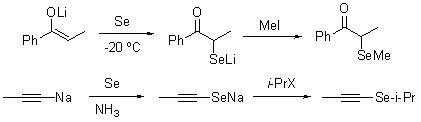
Scheme 1
Selenium is reduced to metal salts of hydrogen selenide or diselenide that are useful precursor of selenides and diselenides, respectively. For example, NaBH4 reduces Se into NaSeH or Na2Se2 depending on the reaction conditions that could be readily reactive with benzyl chloride to give dibenzyl diselenide in high yield (Scheme 2).
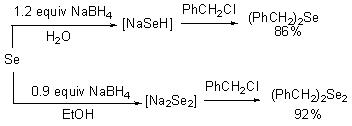
Scheme 2
Reaction of Se with hydrazones, sulfonium or phosphonium ylides and α -halo carbonions gives selones. Sterically hindered selones can be isolated, whereas the less hindered selones can be reacted in situ with ylides (Scheme 3).
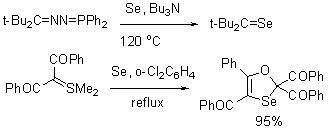
Reaction of Se with diaminoalkyne and isocyanide gives a diselenoamide and isoselenocyanate, respectively (Scheme 4).
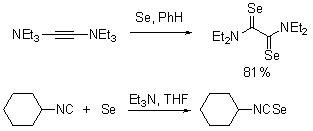
Scheme 4