3.3.4.3 Amination
Ullman showed the C-N cross-coupling of anilines with aryl halides using copper source at elevated temperature (~200°C). Aryl halides having electron withdrawing groups show more reactivity with aryl amines substituted with electron donating groups. Catalytic version of the reaction has been developed during the recent years using copper(I) complex as a catalyst. The nature of the ligand plays a crucial role in the catalysis (Scheme 4). The proposed mechanism is similar to that proposed for the diaryl synthesis from aryl halides and phenols (Scheme 3).
 |
Scheme 4 |
3.3.5 Goldberg Reaction
The C-N cross-coupling of amides with aryl halides using copper source is called Goldberg reaction (Scheme 5). The reaction becomes catalytic when we carry out in the presence of base. The traditional method involved elevated temperature (~200°C), however, the recent methods are effective at moderate temperature where copper (I) complexes are used as catalysts. The proposed mechanism is similar to that of diaryl synthesis (Scheme 3).
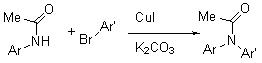 |
Scheme 5 |
Examples:
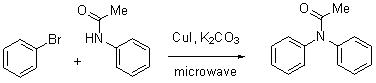 |
J. H.M. Lange, L. J. F. Hofmeyer, F. A. S. Hout, S. J. M. Osnabrug, P. C. Verveer, C. G. Kruse, R. W. Feenstra, Tetrahedron Lett. 2002, 43, 1101. |
3.3.6 Sonogashira Coupling
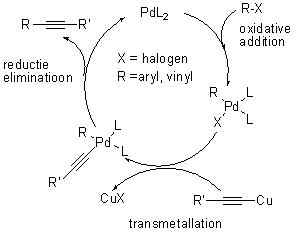
The C-C cross-coupling of aryl halides with alkynes using the combination of Pd and Cu complex is known as Sonogashira coupling reaction. The reactions are effective at moderate temperature with high yield (Scheme 6).
 |
Scheme 6 |
Proposed Mechanism
 |