2.5.2 Bio-reduction
The bio-reduction is one of the important procedures in biological system. There are mainly two different pathways through which most of the biological reductions takes place, enzymatic and non-enzymatic reduction. The advantages of these protocols are, it is very much substrate specific, that they work under ambient condition in aqueous medium.
2.5.2.1 Reduction of Carbonyl Group
The reductions of carbonyl groups have been studied most by using different bio-reductants such as Baker’s yeast or with reductase enzyme. For example, the reductions of β-ketoesters have been studied extensively (Scheme 8). The ethyl acetoacetate could be reduced to give the corresponding 3-hydroxybutyrate. On the other hand, 4-chloroacetoacetate when reduced with Baker’s yeast, gives the corresponding (S)-alcohol with opposite selectivity. Therefore, the stereochemistry of the reduced product depends on the shape and size of the prochiral starting substrates. It also says that the Baker’s yeast has at least two different active reducing sites.
 |
 |
Scheme 8 |
The reduction with Baker’s yeast is very much substrate dependant and it works well with β-keto substrates but it is less selective with other keto-functional substrates. Therefore, it promoted further study on this subject for better results. For example, a better result has been achieved with lyophilized whole cells of Rhodococcus ruber DSM 44541, for asymmetric reduction of aryl ketones and other unfunctional ketones with good enantiomeric excess (Scheme 9).
 |
Scheme 9 |
Another important microorganism is Geotrichum candidum which can perform the asymmetric reduction of aliphatic, aromatic and trifluoromethane substituted ketones with very high enantioselectiovity (Scheme 10).
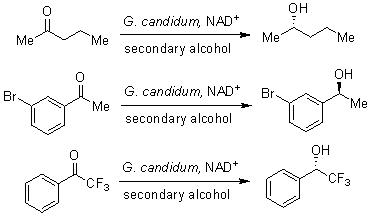 |
Scheme 10 |