2.5.1 Photoreduction
The electron transfer to a certain functional groups can be induced by irradiation with light source. Reductions are possible when a proton source along with a sensitizer and a source of irradiation are employed. The reduction proceeds via photo-induced electron transfer (PET).
2.5.1.1 Reduction of Carbonyl Compound
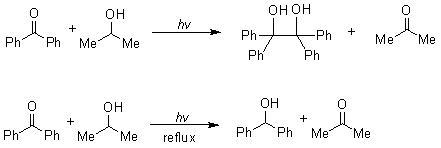
The aliphatic and aromatic carbonyl compounds are reduced to a variety of products depending on the reduction conditions. For examples, the aromatic ketones, benzophenone or acetophenone, in isopropanol or methanol undergo photoreduction to give dimeric pinacol in good yield (Scheme 1). In contrast, benzophenone in isopropanol under reflux condition undergoes photoreduction to give the secondary alcohol Ph2CHOH.
 |
Scheme 1 |
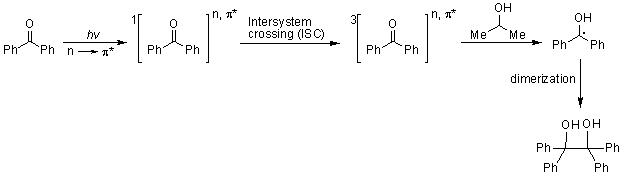
Aliphatic compounds undergo reduction of carbonyl compound to give the corresponding alcohols (Scheme 2). The reaction proceeds via excitation of benzophenone from ground state to excited [n,π*] singlet state (Scheme 3). The excited [n,π*] singlet state then undergoes intersystem-crossing to give [n,π*] triplet state which abstracts proton from the alcohol to generate diphenylhydroxymethyl radical which then dimerises to give the benzpinacol.
 |
Scheme 2 |
 |
Scheme 3 |
 |
Scheme 4 |