2.4.2 Diimide (HN=NH)
Diimide can be prepared in situ, by the copper-catalyzed oxidation of hydrazine in the presence of hydrogen peroxide or oxygen as terminal oxidant or the decomposition of azodicarboxylic acid or sulfonylhydrazines (Scheme 6).
 |
Scheme 6 |
D. J. Pasto, Encyclopedia of Reagents for Organic Synthesis, John Wiley and Sons, Inc., L. A. Paquette, Ed., New York, 1995, 3, 1892. |
• The reagent is extremely tolerant of other functional groups • The reduction is highly stereoselective and takes place cis-addition, from the less-hindered face. |
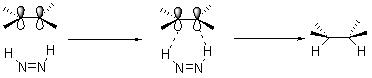 |
• Alkynes show greater reactivity compared to alkenes. • Alkenes with electron withdrawing groups show greater reactivity compared to those with electron donating groups. • Use of deuterium or tritium-labeled diimide gives a method of cis-reduction without scrambling of label. |