9.5 Formation of Carbon-Oxygen Bonds
In a wide variety of environments, C-H bond undergoes oxidation on standing in air to give hydroperoxides. For example, ethers proceed autoxidation to give α -hydroperoxide.
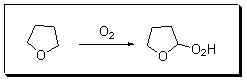
Since hydroperoxides are known to explode on heating, it is essential to remove them (e.g. by reduction with aqueous iron(II) sulfate) from ethers before their use as solvents for the reactions.
Isobutane can be transformed into t-butyl hydroperoxide in the presence of initiator.
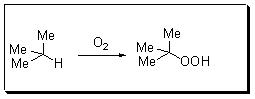
Alkenes are more reactive compared to alkanes due to greater stability of allyl radicals compared to alkyl radicals.

9.6 Formation of Bonds to Other Elements
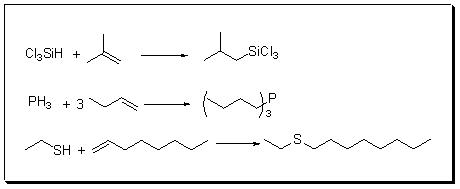
Elements such as sulfur, phosphorus and silicon can proceed reactions with alkenes and alkynes via radical catalyzed process. The characteristics of these reactions are similar to those described above. For examples,