6.1 Principles
There are four principal mechanisms for aromatic nucleophilic substitution which are similar to that of aliphatic nucleophilic substitution.
6.1.1 SN Ar Mechanism
The introduction of electron withdrawing group (EWG) on the aromatic nucleus makes the system susceptible to nucleophilic attack. The mechanism is similar to that of electrophilic substitution except that an anion rather than a cation intermediate is involved. The nucleophile adds to the aromatic ring to afford a delocalized anion from which the leaving group (LG) is eliminated.
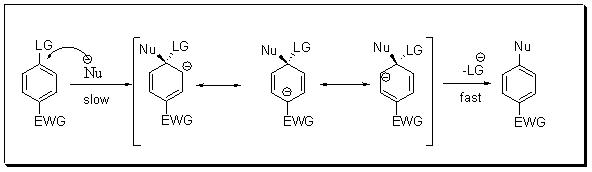
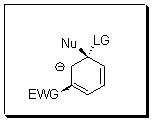
The delocalization of the negative charge can occur only when the nucleophile adds to the ortho or para position with respect to the EWG. Addition to meta position gives an adduct stabilized by the inductive effect, but not the mesomeric effect. Therefore, towards nucleophiles, EWG are activating and ortho, para -orienting and, in contrast, electron donating group (EDG) deactivating and meta directing. These principles are opposite of those that apply to electrophilic substitution.
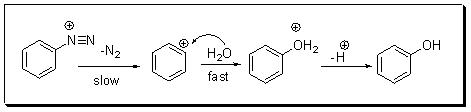
6.1.2 SN Mechanism
This mechanism operates in the reaction of diazonium salts with nucleophiles. The driving force resides in the strength of the bonding in the nitrogen molecule that makes it a particularly good leaving group.