4.3 Addition of Nitrogen Nucleophiles to Unsaturated Carbon
4.3.1 Reactions with Aldehydes and Ketones
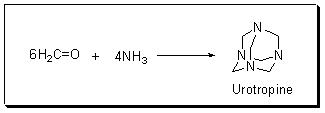
The condensation of aldehydes with amines finds wide applications. The fate of the adduct depends on the structure of the aldehydes, amine, and the reaction conditions. For examples, formaldehyde reacts with ammonia to give urotropine (hexamethylenetetramine).
Aromatic aldehydes generally provide condensation products. This strategy has been used to construct stereoregular chiral main chain polymers from optically active diamines and dialdehydes with excellent yield which are otherwise difficult to access by other methods (Scheme 7).
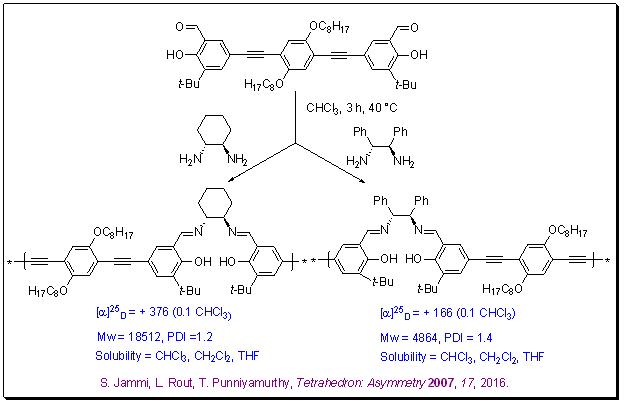
Scheme 7
4.3.1.1 Ugi Reaction
The four-component condensation of isocyanide, a carboxylic acid, an aldehydes or ketone and ammonia or amine gives bisamide (Scheme 8). The product formation probably takes place from a reaction between carboxylic acid, the isocyanide, and the imine formed from the aldehydes or ketone and ammonia or the primary amine. The use of N-protected amino acids allows the reaction to be used for peptide synthesis.
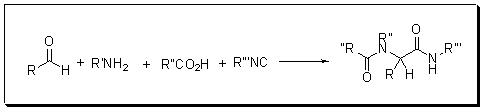
Scheme 11