4.2.3 Gabriel-Colman Rearrangement
Potassium phthalimide proceeds nucleophilic substitution with α -halo acetate and the resulting product in the presence of base undergoes rearrangement to afford isoquinoline derivatives (Scheme 3).
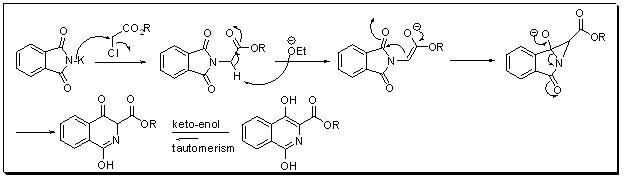
Scheme 3
4.2.4. Reactions of other Nitrogen Nucleophiles
4.2.4.1 Nitrite
Metal nitrites can react with alkyl halides at both nitrogen and oxygen to give nitro compounds and nitrites, respectively, whose proportions depend on the structure of the reactants and reaction conditions. For example, silver nitrite suspended in ether reacts with alkyl halides to give a mixture of nitro-compounds and nitrites whose proportions depend on the nature of alkyl halides (Scheme 4).
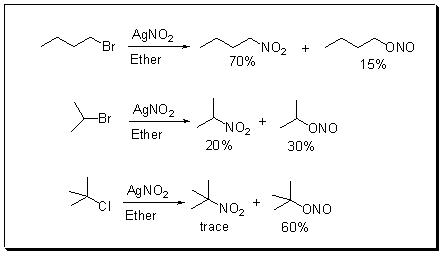
Scheme 4
4.2.4.2 Azide
Azides react with halides to give alkyl azides that could be reduced to afford primary amines (Scheme 5).
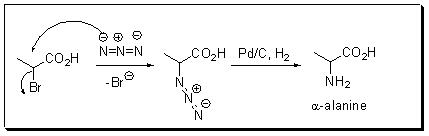
Scheme 5
4.2.4.2 Hydrazine
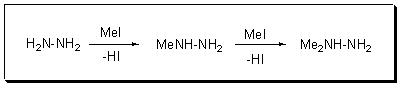
The reaction of hydrazine with alkyl halides generally gives dialkylated products. This is because the introduction of the first alkyl group increases the nucleophilicity of the alkylated nitrogen, so that further alkylation tends to takes place.
Hofmann bromianton of alkylurea can give manoalkylated hydrazines in good yield (Scheme 6).
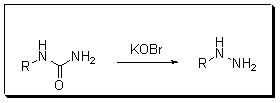
Scheme 6