11.8.3 Heck Reaction
The Heck reaction, is one of the most synthetically important Pd-catalyzed C-C cross-coupling reactions, couples an alkene with a halide or triflate to form a new alkene (Scheme 6). The alkene can be mono- or disubstituted and can be electron-rich, poor or-neutral.

Scheme 6
Asymmetric version of this coupling reaction has also been explored. For example, the chiral palladium complex having amino acid-derived phosphine ligand catalyzes the reaction of phenyl triflate with dihydrofuran with excellent enantioselectivity (Scheme 7).
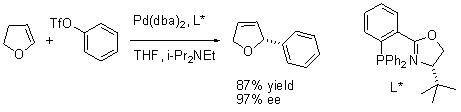
Scheme 7
Likewise, the intramolecular Heck reaction using ( R )-BINAP affords decalin derivative with 80% ee (Scheme 8).

Scheme 8
Mechanism
The mechanism involves the oxidative addition, carbometallation, β -hydride elimination and elimination of the target product (Scheme 9).
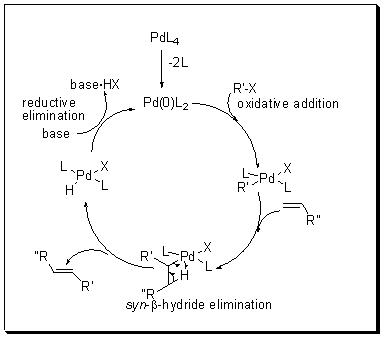
Scheme 9
Examples:
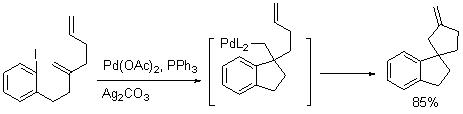
M. M. Abelman, L. E. J. Am. Chem. Soc. 1988 , 110 , 2338.
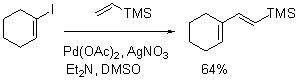
K. Karabelas, A. Hallber, J. Org. Chem. 1988 , 53 , 4909.
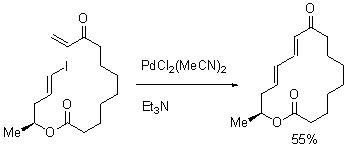
F. E. Ziegler, U. R. Chakroborty, R. B. Weisenfield, Tetrahedron 1981 , 37 , 4035.