11.8 Palladium Catalysts
There are several features which make reactions involving Pd catalysts particularly useful and versatile among many transition metals used for organic synthesis. Most importantly, Pd catalysts offer an abundance of possibilities for carbon-carbon and carbon-heteroatom bonds formation in organic synthesis. The tolerance of Pd catalysts towards many functional groups such as carbonyl and hydroxyl groups is an important feature.
11.8.1 Oxidative Addition
The “ oxidative ” addition is addition of a molecule X-Y to Pd(0) with cleavage of its covalent bond, forming two new bonds (Scheme 1). This process is similar to the formation of Grignard reagent from alkyl/aryl halide and Mg(0).

Scheme 1
The oxidative addition occurs with coordinative unsaturated complexes. As a typical example, the saturated Pd(0) complex undergoes reversible dissociation in situ in a solution to give the unsaturated 16-electrons species which is capable to undergo oxidative addition (Scheme 2) .
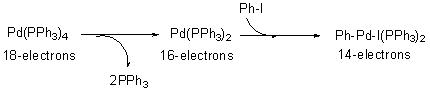
Scheme 2
Oxidative addition is facilitated by higher electron density of Pd, and in general, σ donar ligands such as R3P attached to Pd facilitate the reaction. On the other hand, p acceptor ligands such as CO and alkenes tend to suppress oxidative addition.