3.6.5 Rhodium Catalysts
Rhodium is a silvery white monoisotopic metal of platinum group metals belonging to the 4d series. It is highly inert and thus believed to have any significant biological role. Rhodium is used mainly in the three way catalytic convertors of automobiles for oxidation of incompletely burnt hydrocarbons. It is also alloyed with platinum and palladium for use in high temperature surroundings. The most stable oxidation state of rhodium is +3 but it can show oxidation states ranging from 0 to +6.
3.6.5.1 Hydrogenation
Transition metal catalyzed hydrogenation of alkenes and carbonyl compounds occupies an important position in organic synthesis. Wilkinson's complex, [RhCl(PPh3)3], is one of the most versatile catalysts for the homogeneous hydrogenation process. It is obtained in the form of a red-violet crystalline solid from the reaction of RhCl3 with excess of PPh3 in boiling EtOH (Scheme 1).

Scheme 1
| Ref: K. Burgess, W. A. van derDonk, Encyclopedia of Reagents for Organic Synthesis , John Wiley and Sons, Inc., L. A. Paquette, Ed., New York, 1995, 2, 1253. |
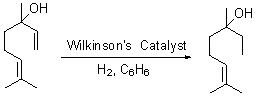
Rhodium-catalyzed hydrogenation is compatible with the substrates having functional groups such as oxo, cyano, nitro, choro and azo, and selectively reacts with the double bond (Scheme 2). Chelation of the functional group on the catalytically active Rh may lead to high degree of selectivity. The reduction takes place from the less-hindered face with a cis -stereochemistry.
Scheme 2