10.4.2.2 Coupling Reaction
Alkylboranes can be coupled using basic silver nitrate via an alkyl silver intermediate that affords a useful tool for the carbon-carbon bond formation (Scheme 7).

Scheme 7
10.4.2.3 Carbonylation: Formation of Alcohols, Aldehydes and Ketones
The reactions of organoboranes with carbon monoxide open up a variety of synthetic pathways for the preparation of alcohols, aldehydes and ketones. For example, 1,5,9-cyclododecatriene with B2H6 provides tricyclic borane that can be converted into tricylic alcohol via carbonylation and oxidation (Scheme 8).
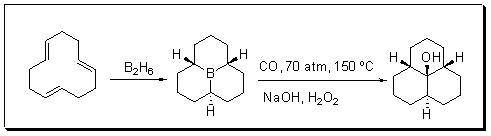
Scheme 8
Mechanism
The reaction involves migration of alkyl groups from boron to the carbon atom of CO (Scheme 9).
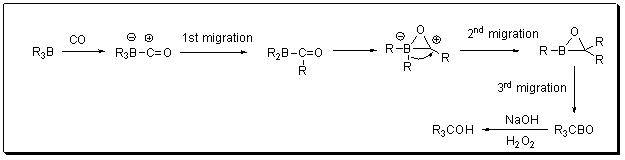
Scheme 9
In presence of a small amount of water, migration of third alkyl group from boron to carbon can be inhibited to give dialkylketone (Scheme 10).
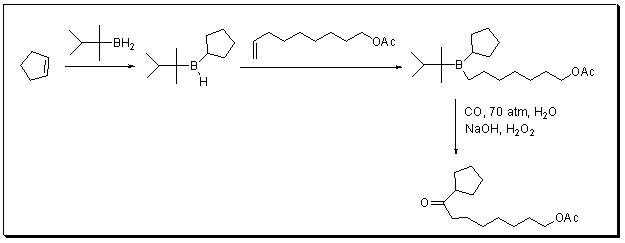
Scheme 10