Pedosphere as Environmental Interface
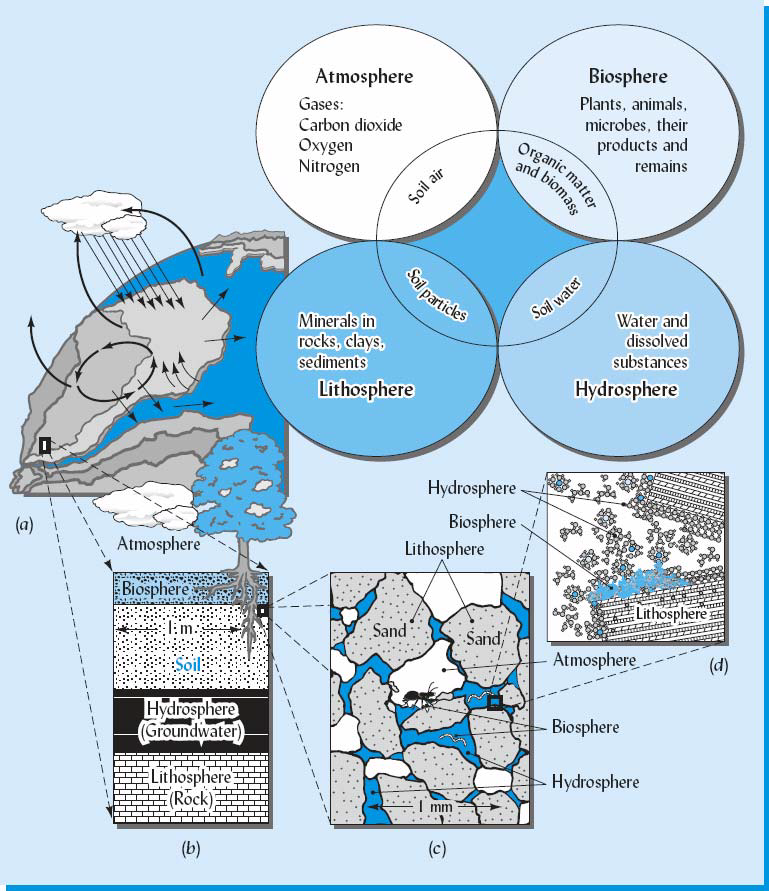 |
The pedosphere—interface of the worlds of rock (the lithosphere), air (the atmosphere), water (the hydrosphere), and life (the biosphere)—can be understood at many different scales. At the kilometer scale (a), soil participates in global cycles and the life of terrestrial ecosystems. At the meter scale (b), soil forms a transition zone between the hard rock below and the atmosphere above—a zone through which surface water and groundwater flow and in which plants and other living organisms thrive. At the millimeter scale (c), mineral particles form the skeleton of the soil that defines pore spaces, some filled with air and some with water, in which tiny creatures lead their lives. Finally, at the micro- and nanometer scales (d), soil minerals (lithosphere) provide charges, reactive surfaces that adsorb water and cations dissolved in water (hydrosphere), gases (atmosphere), and bacteria and complex humus macromolecules (biosphere). (Diagram courtesy of R. Weil) |
•
Soils so deeply affect every other part of the ecosystem that they are often called the "great integrator." M. J. Singer argued that soils are ecosystems by themselves.
•
Soils have six key roles to play:
- Support plant growth;
- Reserve and purify water;
- Function as nature's recycling systems;
- Regulate the atmosphere;
- Provide habitats for a myriad of living organisms;
- Supply engineering materials and building foundations
•
Supplemental Readings for next lecture:
1. Denef, K. et al. 2001. Influence of dry-wet cycles on the interrelationship between aggregate, particulate organic matter, and microbial community dynamics. Soil Biology and Biochemistry, 33:1599-1611.
2. Haynes, R. J. and M. H. Beare. 1997. Influence of six crop species on aggregate stability and some labile organic matter fractions. Soil Biology and Biochemistry, 29:1647-1653.
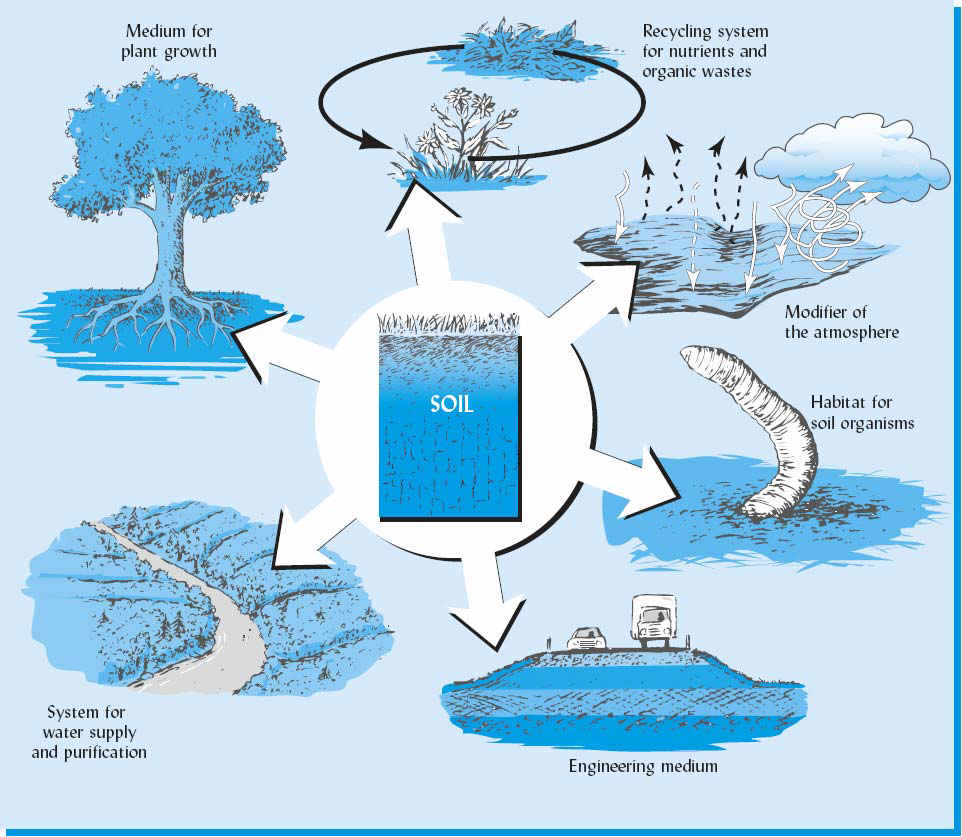 The main functions of soil can be grouped into six crucial ecological roles.