3.11. Enzyme in Organic Synthesis
3.11.1. Introduction
Over the years the use of enzymes as catalysts for the preparation of novel organic molecules has received a steadily increasing amount of attention. Selectivity i.e. to obtain a high yield of a specific product is the prime importance of organic synthesis. There are a large number of selective organic reactions available for most synthetic needs. However, chiral synthesis is a challenging task and the organic chemists are now also struggling in this area, although a considerable progress in asymmetric synthesis has been achieved in recent years.
Since long back, the natural catalyst, the Enzymes are known to active in organic chemical transformation and treated as “green” catalyst. Synthesis of (R)-Mandelonitrile in 1908 is the first example ofenzyme in organic chemistry.
Increasing demand for optically pure compounds for applications in pharmaceuticals, cosmetics, food industry etc., since then Enzymes are being used in a number of biocatalytic application because of the following reasons.
- Enzymes are efficient catalysts
- Biocatalysis is Environmentally "green" and possess high safety profile
- Enzyme catalysis need mild reaction conditions (pH 5-8, 20-40 °C, pressure) which minimizes problems of undesired side-reactions such as decomposition, isomerization, racemization and rearrangement, which often plague traditional methodology.
- They Catalyze a broad spectrum of reactions.
- Biocatalysts can perform transformations that are difficult to emulate using more traditional organic chemistry.
- Enzymes are chiral catalysts and are often able to produce optically active molecules that can be used as building blocks for the preparation of other chiral molecules of biological importance.
- Most importanly, they offers three major types of selectivities: high Chemoselectivity, high Regioselectivity and diastereoselectivity, and Enantioselectivity/stereospecificity
- Biocatalysts save additional reaction steps compared to organic synthesis.
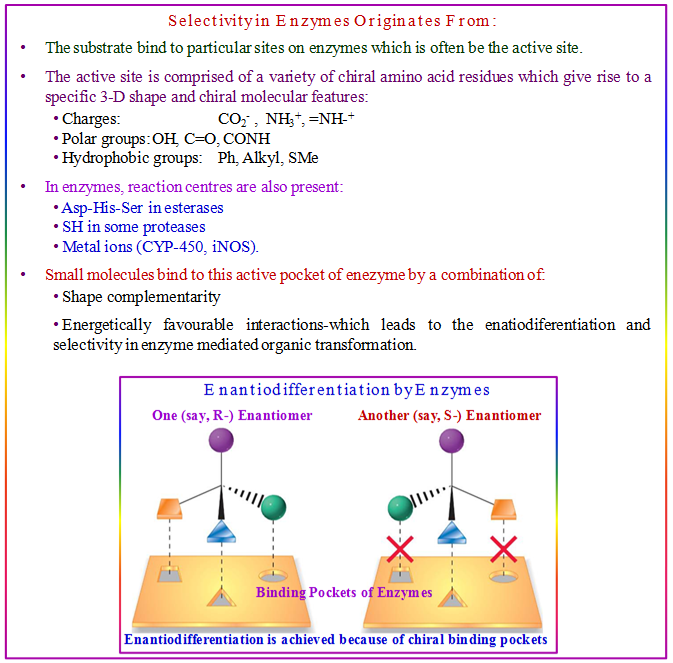
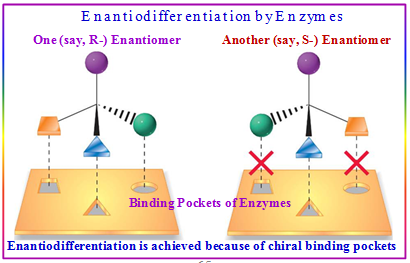
- Enantiodifferentiation is more important feature of enzyme.
- Enzymes speed up the reaction because it binds more tightly to the transition state vs. ground state by factor approximately equal to rate acceleration.
- Enantioselectivity, in principle, has to do with the difference of energy in transition state ΔΔG which is the basis of "chiral recognition".
These reasons, especially the stereoselectivity and stereo differntiation, are the major reasons why synthetic chemists have become interested in biocatalysis. This interest in turn is mainly due to the need to synthesize enantiopure compounds as chiral building blocks for drugs.