The third step is nothing but an oxidation of a secondary alcohol to a ketone. This is a reaction for which we used chromium(VI) oxidizing reagents in organic chemistry, on the contrary, in biology, the oxidizing agent is NAD+ (nicotine adenine dinucleotide cation). The hydrogen attached to the OH-bearing carbon is transferred to the NAD+, and the -OH hydrogen comes away as an H+.
In the final step actual cleavage of the C-C bond between the beta-carbon and the gamma carbonyl group takes place. If we think the final step in reverse way, we can see a pattern which is identical to the Claisen condensation reaction in organic chemistry.
Thus we can conclude that the final step in the beta-oxidation cycle is a reverse Claisen condensation. Like the Claisen condensation itself, this step is possible because the enolate ion obtained as a result of breakage of the acetate fragment which is stabilized by resonance. This enolate ion is neutralized by a proton source. The shortened fatty acid is released from the enzyme as CoASH replaces the sulfur of the enzyme. This last step goes through a tetrahedral intermediate similar to organic chemistry as we would expect for a reaction which converts one carboxylic acid derivative to another.
The acetyl-coenzyme-A formed in this cycle enters the tricarboxylic acid cycle where it is oxidized to two molecules of CO2. The NADH and FADH2 produced in beta-oxidation and the tricarboxylic acid cycle enter a process called oxidative phosphorylation which results in the formation of ATP (adenosine triphosphate) for use in providing energy within the cell.
At last we can conclude that, all the steps catalyzed by enzymes are similar what we can carry out in organic synthesis in laboratory. Overall, that the reactions all occur at the carboxylic acid end of the molecule rather than at the CH3 end is not surprising, since a fundamental idea of organic chemistry is that reactions occur at functional groups rather than elsewhere.
1.11.2. Glycolysis and Its’ Analogy with Organic Chemistry
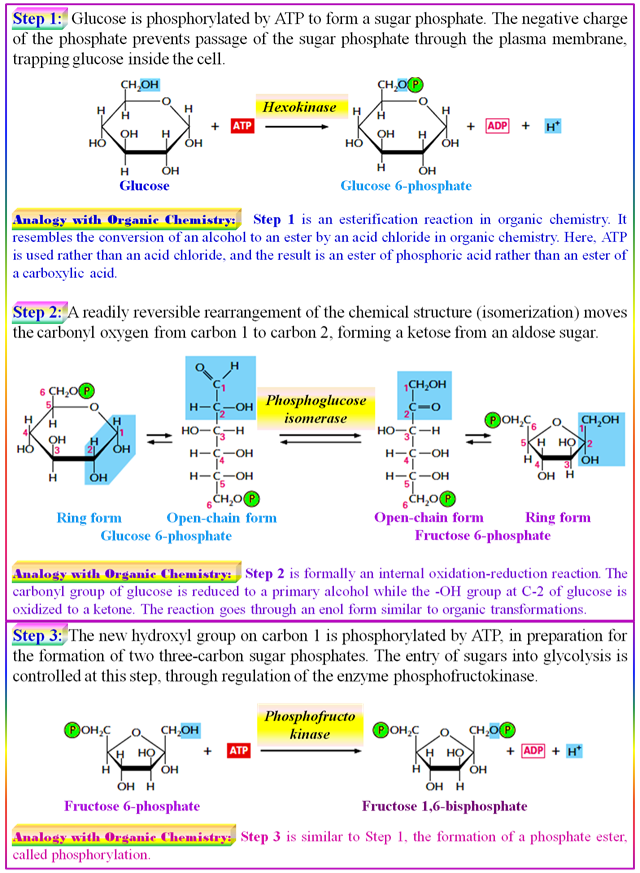
Glycolysis is the conversion of glucose to pyruvate. In the larger scheme of things the pyruvate produced is then converted to acetate, which like the acetate from beta-oxidation of fatty acids, enters the tricarboxylic acid cycle. In this biological process also one can find analogous reaction in organic chemistry. In schematic form the 10 steps of glycolysis are shown along with the analogy with organic chemistry has been elaborated.