| |
Entropic networks
We will now consider the properties of a network of flexible chains which are packed to sufficient density that each chain is in proximity with its neighbours at several locations along its contour length. A cross-linker is then added to this assembly of chains which weld each chain to its neighbour at several random locations. In this process, the network becomes cross-linked; it no longer remains fluidic but attains a rigidity, the extent of which depends upon the density of the cross-linking nodes. Question arises how this network of chain behaves when subjected to external stress. In fact, after crosslinking, each chain segment between the cross-linking nodes in essence behaves like a random chain and its end to end displacement  obey the Gausian probability distribution as discussed earlier. As a result, the contour length of the chain remains unaltered, however the location of the crosslinking nodes does not remain fixed in space at a non-zero temperature; the instantaneous end to end displacement varies. The average value of changes also when the network is subjected to external stresses. In this section we will like to deduce quantitatively how exactly this change occurs. obey the Gausian probability distribution as discussed earlier. As a result, the contour length of the chain remains unaltered, however the location of the crosslinking nodes does not remain fixed in space at a non-zero temperature; the instantaneous end to end displacement varies. The average value of changes also when the network is subjected to external stresses. In this section we will like to deduce quantitatively how exactly this change occurs.
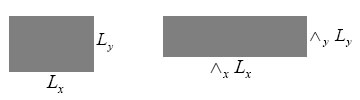
Let us consider that the system is in the shape of a rectangular prism of initial length  , which when deforms result in a prism of length , which when deforms result in a prism of length 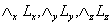 , such that the scaling factors or the extension ratios are greater than 1, , such that the scaling factors or the extension ratios are greater than 1,  for extension but smaller than 1, for extension but smaller than 1,  for compression. Question is how the entropy of the system changes with the factor for compression. Question is how the entropy of the system changes with the factor  . .
After this deformation occurs, the probability that a given chain has a particular end to end displacement vector, 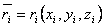 is obtained considering that it has a displacement vector is obtained considering that it has a displacement vector  in the unstressed state but has a displacement vector in the unstressed state but has a displacement vector  after deformation. What is the probability that the displacement vector of the chain lies within the range after deformation. What is the probability that the displacement vector of the chain lies within the range  to to  after deformation. after deformation.
This probability is written as  , where, , where,

is the three dimensional probability density function as derived earlier. Here, for a three dimensional chain of  equal segments of length equal segments of length  , ,  (equation 37.15). Using the above relation we can obtain the probability that a chain lies within the above volume element is, (equation 37.15). Using the above relation we can obtain the probability that a chain lies within the above volume element is,
 |
(40.6) |
|