Three dimensional networks (contd...)
We will like to explore how these moduli are related to microscopic structure of a material. We will consider a network of identical springs, each having a potential energy  , where , where  is the spring constant and is the spring constant and  is the unstretched length of the spring. The figure shown below depict that all springs change their length from to is the unstretched length of the spring. The figure shown below depict that all springs change their length from to  , i.e. the cube undergoes pure compression with the diagonal elements of the strain tensor defined as , i.e. the cube undergoes pure compression with the diagonal elements of the strain tensor defined as  , the off-diagonal elements are all zero. , the off-diagonal elements are all zero.
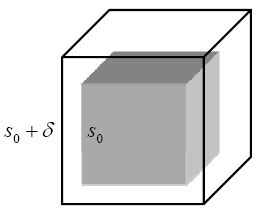
Then the change in free energy density is obtained from equation 40.3 as,
 |
(40.4) |
How many springs are there per unit cell? The cubical unit cell shown above consists of a single vertex (each of the eight vertices of the cell is shared by eight neighbouring cells) and three springs (each of the twelve chains of the cell is shared by four neighbouring cells). Therefore, because of the deformation of the cell, change in potential energy is deduced as  , dividing it by the volume yields the strain energy density, , dividing it by the volume yields the strain energy density,
 |
(40.5) |
The compression modulus can then be found by comparing 40.4 and 40.5 to obtain,  , showing that elastic moduli depend upon the spring constant and the spring length in the equilibrium condition. , showing that elastic moduli depend upon the spring constant and the spring length in the equilibrium condition.
|