Entropic networks (contd...)
But the question is how many of the  individual segments have number of chains individual segments have number of chains  for each range for each range  . We can choose out of in . We can choose out of in  number of ways. The probability that any one of these configurations will have the end to end displacement is given by the above relation for number of ways. The probability that any one of these configurations will have the end to end displacement is given by the above relation for  in equation 40.6. Hence the probability that all of the configurations will have the end to end displacement is given as, in equation 40.6. Hence the probability that all of the configurations will have the end to end displacement is given as,
 |
(40.7) |
We need to find out also the probability that each cross-linking site lies within an appropriate distance, essentially within a volume element  of a site of a neighbouring chain in order that the crosslinking happens. An estimate of this probability can be written as, of a site of a neighbouring chain in order that the crosslinking happens. An estimate of this probability can be written as,
 |
(40.8) |
So the probability that a network has a particular configuration after deformation is the product of above two probabilities, i.e.  . The corresponding entropy of the network is written as . The corresponding entropy of the network is written as  , where , where  is the Boltzman constant. Expanding for the expression for is the Boltzman constant. Expanding for the expression for  and and  , and simplifying, the expression of entropy is obtained as, , and simplifying, the expression of entropy is obtained as,
 |
(40.9) |
Hence the change in entropy from the reference state of unstretched configuration: 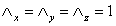 , is , is
 |
(40.10) |
Hence the free energy change is obtained as 
 |
(40.11) |
Considering that volume conservation requires  , we have , we have
 |
(40.12) |
For pure shear  and and  , so that the expression for free energy simplifies to , so that the expression for free energy simplifies to
 |
(40.13) |
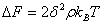
Putting  and considering that and considering that  is small, the change in free energy is obtained as is small, the change in free energy is obtained as . Dividing this expression by undeformed volume . Dividing this expression by undeformed volume  we obtain, we obtain,
 |
(40.14) |
Where  is the density of chains. From 40.1 for pure shear conditions, , such that is the density of chains. From 40.1 for pure shear conditions, , such that  , ,  and and  we obtain we obtain
 |
(40.15) |
Comparing equation 40.14 and 40.15, the shear modulus of the network is obtained as
 |
(40.15) |
Computer simulation of networks confirms the density dependence of the shear modulus as derived above. |