The reset term causes the control action changing as long as there exists a non-zero error in the system. Often this error cannot be eliminated quickly and given enough time, they produce larger values for integral terms. Such situation is often observed when the system undergoes a large change in setpoint (say a positive change) and the integral term accumulates a significant error during the rise. This condition is termed as Integral Windup . The control action in turn keeps on increasing until it reaches the control valve saturation ( i.e. control valve fully open or fully closed). Even if the error changes its sign (as the process output overshoots the desired setpoint), this accumulated error has to unwind completely before control action is reversed. Various measures can be taken to address the issue of integral windup such as:
• Re-initializing the integral action to a desired value
• Increasing the setpoint in a suitable ramp (rather than a single step jump)
• Disabling the integral action until the process output enters the controllable region
• Preventing the integral term from accumulating above or below pre-determined bounds
IV.1.3.3 Proportional Integral Differential Controllers
The actuating output of a PID controller is given as:
 |
(IV.9) |
where  is the derivative time constant (or the preact time) in minutes. The PID controller not only actuates on the basis of current and past errors but it also anticipates the error in immediate future and applies an additional control action which is proportional to the current rate of change of error. Hence the transfer function of the PID controller is
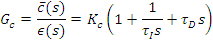 |
(IV.10) |
In industrial lingo, the PID Controller is also termed as “Gain-Reset-Preact” controller.
The major drawback of a PID controller is that for a noisy response in a process, the controller can erroneously actuate a high derivative control action.