IV.1.3.1 Proportional Controllers
The actuating output of a P controller is proportional to the error between the setpoint and process output. Higher the error, higher will be the control action. The control law is given as:
 |
(IV.1) |
where  is
called
the gain of the controller and
is
called
the gain of the controller and  is the bias signal. When error signal
  is zero (i.e., the process output reaches its desired setpoint), the control signal
  stabilizes at its bias value
  . The deviation form of actuating signal is
 |
(IV.2) |
Hence the transfer function of the proportional controller is
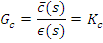 |
(IV.3) |
In industrial lingo, the proportional controller is also termed as “Gain” controller. Equivalent representation of proportional gain is proportional band . It is the amount of change in error that will cause the control action to go from full OFF to full ON. The amount of change in error is calculated as a percentage of full-scale error,
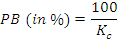 |
(IV.4) |
e.g. , consider a level controller acting on a tank where we measure the level from bottom to top as 0 to 100%. A control valve on the outlet of the tank maintains the level in the tank. The PB is defined as the range of level over which the control valve will go from fully closed to fully open . Let us take the example of a tank whose maximum level is 5 m. Suppose we decide that if the tank level should fall to 20% (1 m) we want the control valve fully closed (0% open) and if the tank level rises to 60% (3 m) we want the control valve to be fully open (100% open). If the tank level is between 20% and 60% we want the control valve to be open in pro rata basis. This controller would have a PB of 40% (60% - 20%). So if the tank level were to rise to 2.5 m or 50% of the full tank (75% up the PB), the control valve should be set to 75% open).