As the name suggests, an open loop process does not have any feedback loop mechanism. It consists of only the process along with its two inputs ( u and d) and one output (y). Input  is available for manual manipulation that is required for modeling exercise. On the other hand closed loop process has a feedback loop mechanism that consists of measuring device, controller and final control element. The process input
 is not available for manual manipulation, rather the controller (and the final control element) ensures automatic manipulation of . However, a setpoint
  for the process output is available for manual manipulation in case the process objective demands so.
Fig. IV.2 demonstrates some typical feedback control systems which are often encountered in a chemical process plant. This is an example of a distillation column. There are six control loops in this example, one each for pressure, temperature, flow, level, reflux
and composition. The measurements are done through an appropriate measuring device cum transmitter (denoted by PT, TT, FT, LT, RT
and CT). The measured output is compared with the respective setpoints (denoted by Psp , Tsp , Fsp , Lsp , Rsp and Csp) and errors are fed to the respective controllers (denoted by PC, TC, FC, LC
, RC and CC) and control actions are subsequently initiated by their corresponding valves.
|
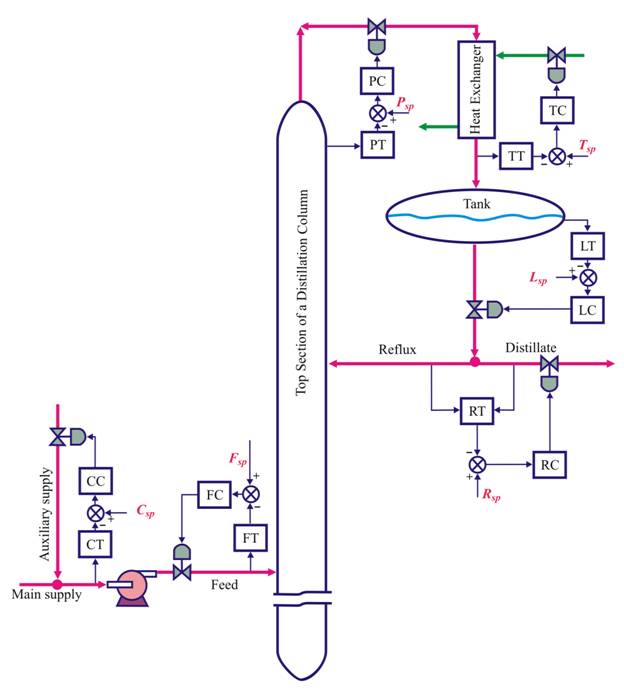 Fig. IV.2: Schematic of a typical feedback control configuration of a distillation column