IV.1 Introduction to Feedback Control
Consider a chemical process plant shown in the Fig IV.1. It has an output  that needs to be maintained at a desired setpoint
  . The process is subjected to unavoidable disturbance (load)
  . One input is available in the process that can be manipulated in order to steer the process to its desired setpoint . Hence, in the event of process disturbance drifting the process output away from its desired setpoint, the objective of feedback control is to steer the process output at its setpoint by manipulating the process input.
|
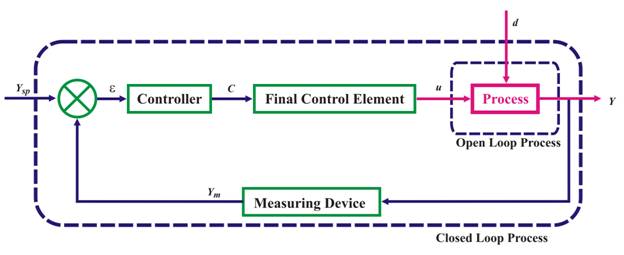 Fig. IV.1: A conceptual block diagram of feedback control loop of a chemical process
 A feedback control law consists of the following steps of action:
• Measurement of process output  , such as pressure, temperature, flow, level, composition, using a suitable measuring device.
• Comparison of process output and its desired setpoint  and calculation of the deviation error
• Feeding the value of deviation error to the controller, which calculates the appropriate control action to be taken.
• Feeding the value of the control action to the final control element, that translates the control action into manipulated form of process input  .
.