Long Range Forces
These forces are important considering their range to be greater than the half the length of the box. They are the most difficult to treat because they decay faster than r-n, where n is the dimensionality of the system. A long range force is defined typically for the charge interaction between ions (~ r-1) and the dipole dipole (r-3) interaction between molecules. This creates problem as the range is often greater that half the box length. So in a way the charge-charge interaction which decays with r-1 is the most troublesome. Thus it is necessary to model the long range forces accurately. This is important since some properties such as dielectric constant depends on the long range forces. A number of methods have been developed to handle long range forces such as Ewald Summation, the reaction field method and the cell multipole method.
The mathematical details can be found from [de Leeuw et al.,1980] and [Heyes ,1981]
Ewald Summation Method
The method uses the fact that the particle interacts with all other particles in the simulation box and also with all of their images in an infinite array of periodic cells. The figure below illustrates the construction of array of simulation cells where the cell array is considered to be spherical.
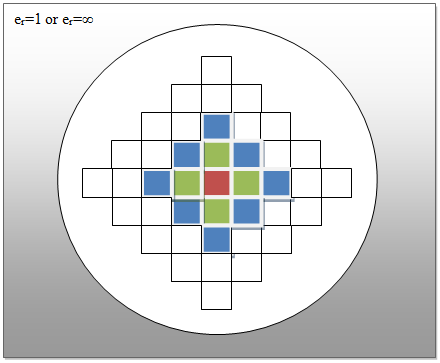
Figure 12 : Construction of system of periodic cells in Ewald Summation method (Adapted from Allen and Tilsedley,1987,Computer Simulations in Liquids .Oxford,Oxford University Press.)
Each box of the system is considered to be cube of N charges and of side L. The position of each box is related to the central box by specifying a vector whose components are integral multiples of the box length i.e (  , 0, 0), ( 0,
 , 0), ( 0,0,
 ).Here i, j, k takes up values of 0,1,2,3……We are in a position to define the charge charge contribution to the potential energy due to pairs of charges in the central simulation box .
