Choosing a time step for the integrations is a balance between steps that are too small, so that the simulation to obtain accurate equilibrium thermodynamics averages will take too long; and steps that are too large leads to errors due to numerical integration. Due to this instabilities can arise as a result of an interaction (or collision) where the atom undergoes a large velocity change or even velocity reversal within the time step. Such instabilities could also lead to a violation of energy and linear momentum conservation[Leach,2001].
When simulating an atomic fluid the time step should be small as compared to the mean time between collisions. While simulating flexible molecules a useful guide is that the time step should be approximately one tenth the time of the shortest period of motion. Time steps of the order of fentoseconds (one-quadrillionth of a second) are typical. The Table below suggests time steps for different kind of motion.
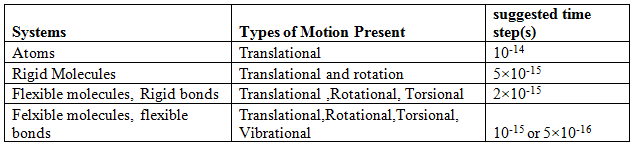
Table 1: Suggested time steps for different motions (Adapted from Leach,2001)