Here 'ls(l)' is the function that depends on the coordinates of electron 1 (r1) and 'ls(2)'
a function depending upon the coordinates of electron 2 (r2). Applying the indistinguishability criterion for electrons, we obtain the same function when we exchange the electrons. In other words, wavefunction corresponding to ls(l)ls(2) is the same as ls(2)ls(l). Thus for the wavefunction the exchange of electrons is independent of the electron labels and does not affect the electron density. However the energy of either wavefunction is two times than that of a single electron in a 1s orbital. Let us now consider the excited state. For the first excited state, one electron jumps to the 2s orbital. So the two possible wavefunctions for this state are (Leach,2001):
1s(1) 2s(2)
1s(2) 2s(1)
Now an important question can be asked regarding the indistinguishability criterion. Do we obtain the same absolute value of the function when we exchange the electrons? The answer is we do not obtain the same wavefunction(in magnitude) as 'ls(l)2s(2)' and 'ls(2)2s(l)' are not the same. However a linear combination of both the wavefunctions may give us acceptable solution to the pseudo helium atom.Thus the possible wavefunctions are (Leach,2001):
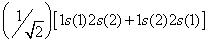
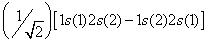
The factor  indicates normalized wavefunction. Out of the total three functional wavefunctional we have stated can be classified as symmetric or antisymmetric. Symmetric ones are those which do not change signs when the electrons are exchanged. Whie the antisymmetric are the ones where the sign changes when the electrons are exchanged.In equation they are described as
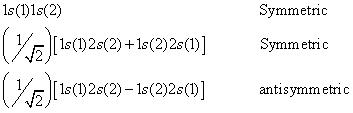
So after discussing the spatial part, we now move our attention to the effects of electron spin. The two electrons 1 and 2 have four spin states namely: .The indistinguishability criterion is also valid for the spin functions. So the possible spin wavefunctions are :
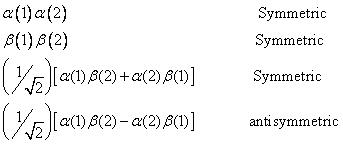
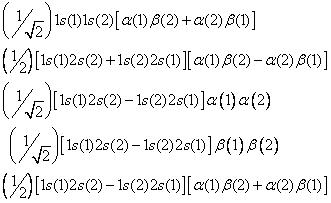
As per definition(Leach,2001) the combination of the spin and spatial wavefunctions ,should only result in antisymmetric overall wavefunction especially when the electrons are excahnged. Thus the possible pathways is to combine a a symmetric spatial part with an antisymmetric spin part, or an antisymmetric spatial part with a symmetric spin part. Thus the permissible functional forms for the wavefunctions of the ground and first few excited states of the helium atom are given as below(Leach,2001):