9.6 Method of feeding: Multiple effect evaporators
The fig.9.5, 9.6, 9.7, and 9.8 show the four different feeding arrangement of feed to the evaporators. In the fig.9.5 the liquid feed is pumped into the first effect and the partially concentrated solution is sent to the second effect and so on. The heating steam is also sent through the first effect to another effect. This particular strategy is known as forward feed. In the forward feed the concentration of the liquid increases from first effect to the subsequent effects till the last effect. It may be noted that the first effect is that in which the fresh steam is fed, whereas the vapour generated in the first effect is fed to the next evaporator (connected in series with the first effect) is known as second effect and so on.
The forward feed requires a pump for feeding dilute solution to the first effect. The first effect is generally at atmospheric pressure and the subsequent effects are in decreasing pressure. Thus, the liquid may move without the pump from one effect to another effect in the direction of decreasing pressure. However, to take out the concentrated liquid from the last effect may need a pump.
The backward feed arrangement is very common arrangement. A triple-effect evaporator in backward arrangement is shown in the fig.9.6. In this arrangement the dilute liquid is fed to the last effect and then pumped through the successive effects to the first effect. The method requires additional pumps (generally one pump in between two effects) as shown in the fig. 9.6. Backward feed is advantageous and gives higher capacity than the forward feed when the concentrated liquid is viscous, because the viscous fluid is at higher temperature being in the first effect. However, this arrangement provides lower economy as compared to forward feed arrangement.
The combination of forward-feed and backward-feed is known as mixed feed arrangement. In mixed feed the dilute liquid enters in between effects, flows in forward feed to the end of the effect and then pumped back to the first effect for final concentration. Figure 9.7 shows triple effect mixed feed arrangement. This mixed feed arrangement eliminates the need of a few of the pumps. Moreover, it still passes the most concentrated liquid through the first effect, which is having higher temperature among all the effect (being at highest pressure compared to other effects).
Another common evaporator arrangements, which is more common in crystallization is parallel feed where feed is admitted individually to all the effects. Figure 9.7 shows such arrangement.
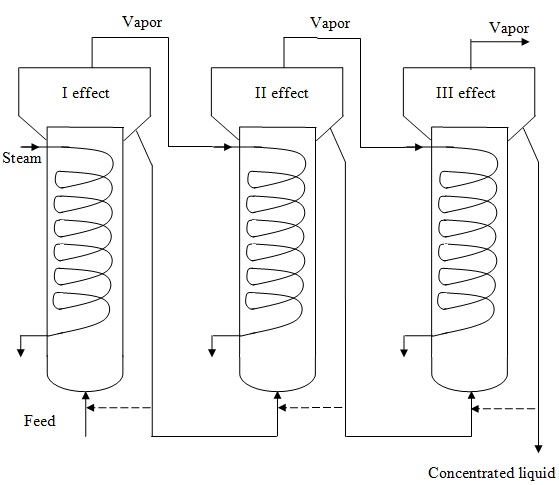
Fig.9.5: Forward feed arrangement in triple-effect evaporator (dotted line: recycle stream)
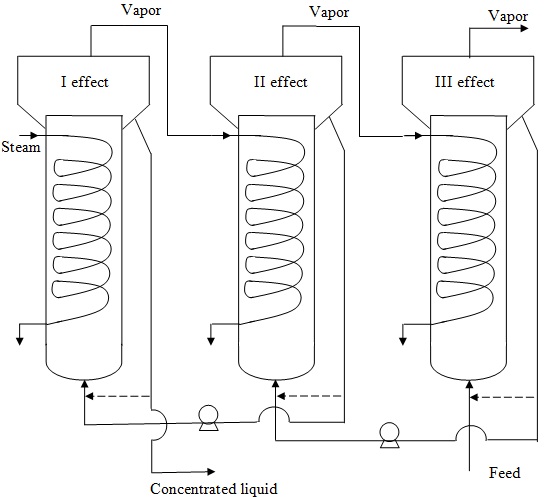
Fig.9.6: Backward feed arrangement in triple-effect evaporator (dotted line: recycle stream)