9.4 Temperature profile in an evaporator
Let us consider the case of long-tube vertical evaporator heated by steam. After boiling and flashing of the superheated liquid, the disengagement of the vapor and liquid occur in vapor space of the evaporator and the recycled liquid flows down the external pipe. A part of this concentrated liquid is withdrawn as a product and the remaining part get mixed with a feed and again enter the evaporator tube. If TBP is the boiling of the liquid in the evaporator as the prevailing pressure, then the temperature of the liquid in the tube will be TBP. The temperature of the recycled stream entering the tubes will then also be TBP, if the feed is sufficiently hot. Now, we will imagine how the temperature is changing in the tube. Let us see that when the liquid flows up in the tube, its temperature rises because at the bottom of the tube the pressure is higher (vapor chamber pressure + hydrostatic pressure + frictional loss) as compared to the top of the tube. Therefore, a liquid starts boiling at a level when its temperature rises to its saturation temperature at the pressure at that point. After the boiling in between the tube, as liquid goes up in the tube, the local temperature drops because of the reduction in the local pressure. It may also be mentioned that as the liquid moves up it gets concentrated and thus the boiling point of the solution also increases as the liquid traversed up in the tube. The liquid temperature profile in the tube is shown in the fig.9.4 for low (plot i) and high (plot ii) liquid velocity. The liquid temperature in the tubes increases up to certain height and then the temperature decreases due to the loss of superheat. At higher velocity the temperature raise is less and the liquid boils near the top of the tube. The plot (iii) shows the shell side temperature profile where steam is heating the tube. As can be seen, the slightly superheated steam enters the shell and soon the temperature of the steam losses its sensible heat and then condenses on the tubes and provide the latent heat of condensation (at temperature Tsteam) to the tube and before boiling from the shell may get slightly sub-cooled. The plot (iv) is the boiling temperature of the water (Tw) at the pressure in the vapor chamber. Thus, the BPE=TBP-Tw and the true temperature during force is the difference between the plot (iii) and the plot (i) or (ii).
It can be understood with the help of the discussion and fig.9.4 that the temperature changes all along the length of the tube. Thus, the real temperature driving force will be the difference in steam temperature and liquid temperature always the high. However, it is practically not easy to determine the temperature profile in the tube. Therefore, the driving force can be taken as (Tsteam - TBP) for the design purpose.
9.5 Heat transfer coefficient
The correlation used in the boiling and condensation may be used here. If the evaporator operates at very high liquid velocity so that the boiling occurs at the top end of the tube, the following correlation (eq. 9.1) may be used,
|
(9.1) |
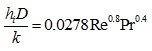
where, D is the inner diameter of the tube, k is the thermal conductivity of the liquid or solution.
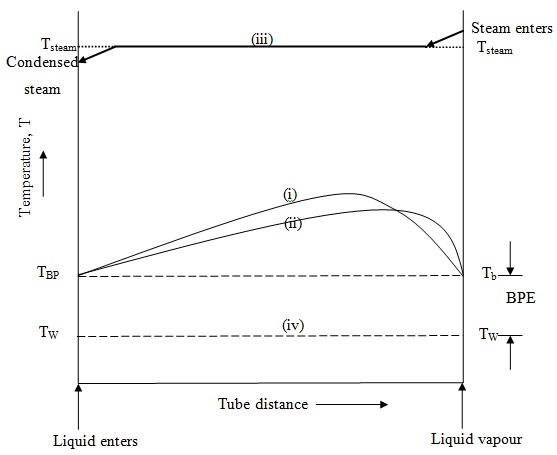
Fig.9.4: Temperature profiles in an evaporator
Fouling is a concern in the evaporator; therefore the following equation (eq.9.2) may be used for the overall heat transfer coefficient with time,
|
(9.2) |
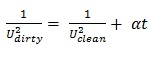
where, t is the time for where the evaporator is the operation, α is a constant for a particular liquid, Udirty and Uclean all the overall heat transfer coefficient of the dirty and clean evaporator.