In order to increase the economy we may consider the arrangement of the two evaporators as shown in the fig. 9.2.
The figure 9.2 shows that the two evaporators are connected in series. The saturated vapor coming out from the evaporator-1 is used as steam in the second evaporator. Partially concentrated solution works as a feed to the second evaporator. This arrangement is known as double effect evaporator in forward feed scheme. A few of the important point that we have to note for this scheme is that the vapour leaving evaporator-2 is at the boiling temperature of the liquid leaving the first effect. In order to transfer this heat from the condensing vapor from the evaporator-1 to the boiling liquid in evaporator-2, the liquid in evaporator-2 must boil at a temperature considerable less than the condensation temperature of the vaporization, in order to ensure reasonable driving force for heat transfer. A method of achieving this is to maintain a suitable lower pressure in the second effect so that the liquid boils at a lower temperature. Therefore, if the evaporator-1 operates at atmospheric pressure, the evaporator-2 should be operated at same suitable vacuum.
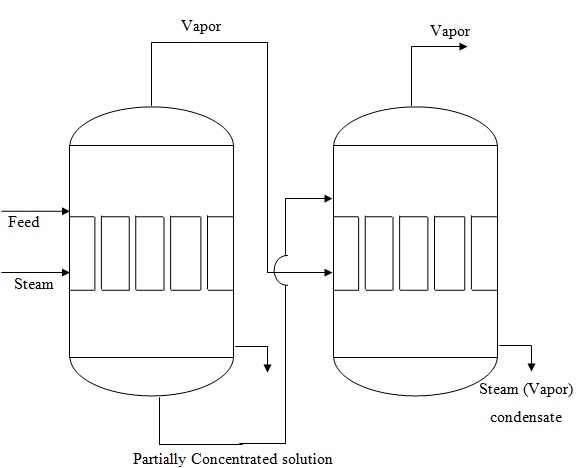
Fig.9.2: Double effect evaporator with forward feed scheme
The benefit of the use of multiple effect evaporators is that in this arrangement multiple reuse of heat supplied to the first effect is possible and results in improved steam economy.
9.3.3 Boiling point elevation
The evaporators produce concentrated solution having substantially higher boiling point than that of the solvent (of the solution) at the prevailing pressure. The increase in boiling point over that of water is known as boiling point elevation (BPE) of the solution. As the concentration increases the boiling point of the solution also increases. Therefore, in order to get the real temperature difference (or driving force) between the steam temperature and the solution temperature, the BPE must be subtracted from the temperature drop. The BPE may be predicted from the steam table (in case water is a solvent).
An empirical rule known as Dühring rule is suitable for estimating the BPE of strong solution. The Dühring rule states that the boiling point of a given solution is a linear function of the boiling point of the pure water at the same pressure. Therefore, if the boiling point of the solution is plotted against that of the water at the same pressure, a straight line results. Different lines are obtained at different concentrations. The fig. 9.3 shows representative Dühring plots for a solution (non-volatile solute in water).
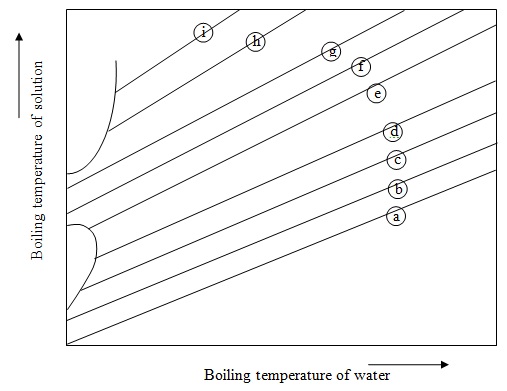
Fig.9.3: Representative Dühring lines for a system (non-volatile solute in water) mole fraction of solute in the solution (a) 0.1 (b) 0.2 (c) 0.25 (d) 0.39 (e) 0.35 (f) 0.45 (g) 0.5 (h) 0.6 (i) 0.7
The fig.9.3 helps to find out the boiling point of solution at moderate pressure. For example if a solution having ‘x’ mole fractions of solute have a pressure over it such that water boils at T° C, by reading up from the x-axis at T °C to the line for the x mole fraction solution and then moving horizontally to the y-axis, the boiling point of the solution can be found at that pressure.