9.2.2 Forced circulation evaporator
Natural circulation evaporators have many limitations (as mentioned earlier) through they are economical as compared to forced circulation evaporator. A forced circulation evaporator has a tubular exchanger for heating the solution without boiling. The superheated solution flashes in the chamber, where the solution gets concentrated. In forced circulation evaporator horizontal or vertical both type of design is in- practice. The forced circulation evaporators are used for handling viscous or heat sensitive solution.
9.2.3 Falling film evaporator
Highly heat sensitive materials are processed in falling film evaporators. They are generally once-through evaporator, in which the liquid enters at the top, flows downstream inside the heater tubes as a film and leaves from the bottom. The tubes are heated by condensing steam over the tube. As the liquid flows down, the water evaporates and the liquid gets concentrated. To have a film inside of the tube, the tube diameter is kept high whereas the height low to keep the residence time low for the flowing liquid. Therefore, these evaporators, with non-circulation and short resistance time, handle heat sensitive material, which are very difficult to process by other method. The main problem in falling film evaporator is the distribution of the liquid uniformly as a thin film inside the tube.
9.3 Performance of steam heated tubular evaporators
The performance of a steam heated tubular evaporator is evaluated by the capacity and the economy.
9.3.1 Capacity and economy
Capacity is defined as the no of kilograms of water vaporized per hour. Economy is the number of kg of water vaporized per kg of steam fed to the unit. Steam consumption is very important to know, and can be estimated by the ratio of capacity divided by the economy. That is the steam consumption (in kg/h) is
Steam Consumption = Capacity / Economy
9.3.2 Single and multiple effect evaporators
In single effect evaporator, as shown in fig. 9.1, the steam is fed to the evaporator which condenses on the tube surface and the heat is transferred to the solution. The saturated vapor comes out from the evaporator and this vapor either may be vented out or condensed. The concentrated solution is taken out from the evaporator.
Now we can see if we want the further concentrate, the solution has to be sent into another similar evaporator which will have the fresh steam to provide the necessary heat.
It may be noted that in this process the fresh steam is required for the second evaporator and at the same time the vapor is not utilized. Therefore it can be said the single effect evaporator does not utilized the steam efficiently. The economy of the single effect evaporator is thus less than one. Moreover, the other reason for low economy is that in many of the cases the feed temperature remains below the boiling temperature of the solution. Therefore, a part of the heat is utilized to raise the feed temperature to its boiling point.
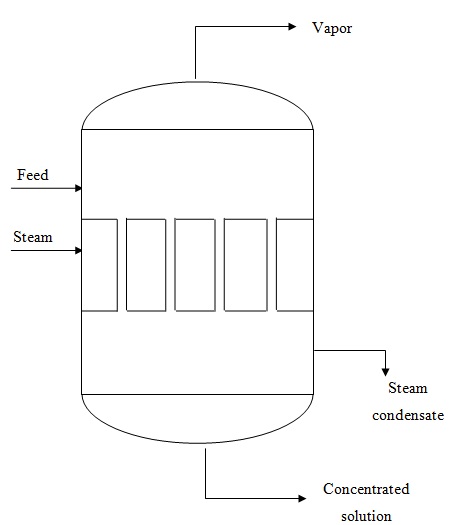
Fig.9.1: Single effect evaporator