The hydraulic diameter (Dh) for the shell can be calculated by the following equation (eq. 8.14),
|
(8.14) |
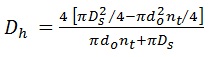
where,
| nt = number of tubes in the shell | |
| do = outer diameter of the tube |
The friction factor (fs) can be obtained by the Moody’s chart for the corresponding Reynolds number 
8.2.8. Heat transfer effectiveness and number of transfer units (NTU)
The LMTD is required to be calculated for the evaluation of heat exchanger performance. However, the LMTD cannot be directly calculated unless all the four terminal temperatures (Tc,i, Tc,o, Th,i, Th,o) of both the fluids are known.
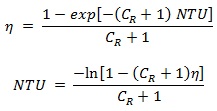
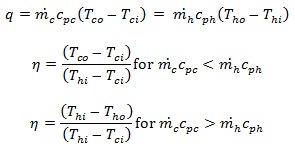
Sometimes the estimation of the exchanger performance (q) is required to be calculated on the given inlet conditions, and the outlet temperature are not known until q is determined. Thus the problem depends on the iterative calculations. This type of problem may be taken care of using performance equivalent in terms of heating effectiveness parameter (η), which is defined as the ratio of the actual heat transfer to the maximum possible heat transfer. Thus,
|
(8.15) |

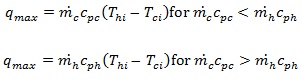
For an infinite transfer area the most heat would be transferred in counter-current flow and the qmax will be dependent on the lower heat capacity fluid as such,
The actual heat transfer
The capacity ratio, which is the relative thermal size of the two fluid streams, is defined as,
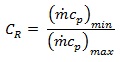
On careful analysis, we can say that
U·A: Heat exchange capacities per unit temperature difference.
This thermal sizing (U·A) can be non-dimensionalised by dividing it to the storage capacity of one of the fluid streams. Given  limits the maximum heat transfers. The non-dimensional term obtained is known as the number of transfer units (NTU)
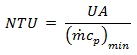
It should be noted that
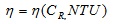
The actual determination of this function may be done using heat balances for the streams. For a parallel flow exchanger the relation is shown below