8.2.7 Pressure drop in the heat exchanger
Pressure drop calculation is an important task in heat exchanger design. The pressure drops in the tube side as well as shell side are very important and quite a few co-relations are available in the literature. One such co-relation is given below in the subsequent subsection.
8.2.7.1 Correlation for tube side pressure drop (eq. 8.10)
|
(8.10) |
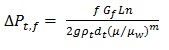
where,
| ΔPt,f = total pressure drop in the bundle of tube | |
| f = friction factor (can be found out from Moody’s chart) | |
| Gt = mass velocity of the fluid in the tube | |
| L = tube length | |
| n = no of tube passes | |
| g = gravitational acceleration | |
| ρt = density of the tube fluid | |
| di = inside diameter of the tube | |
m =0.14 for Re > 2100 |
The above correlation is for the pressure drop in the tubes owing to the frictional losses. However in case of multi pass flow direction of the flow in the tube changes when flow is from 1-pass to another pass and the pressure losses due to the change in direction is called return-loss. The return-loss (ΔPt,r) is given by eq.8.11,
|
(8.11) |
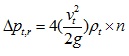
| n = no of tube pass | |
| vt = velocity of the tube fluid | |
| ρt = density of the tube fluid |
Therefore, the total tube side pressure drop will be,
Δpt = ΔPt,f + ΔPt,r
8.2.7.2 Correlation for shell side pressure drop
The following correlation (eq.8.12) may be used for an unbaffled shell,
|
(8.12) |
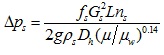
The above equation can be modified to the following form (eq.8.13) for a baffled shell,
|
(8.13) |
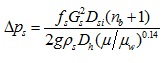
where
L = shell length |
|
ns = no of shell pass |
|
nb = no of baffles |
|
ρs = shell side fluid density |
|
| Gs = shell side mass velocity | |
Dh = hydraulic diameter of the shell |
|
Dsi = inside diameter of shell |
|
fs = shell side friction factor |