It is also assumed that the radiosity and irradiation are uniform over each surface. As we have already discussed that the radiosity is the sum of the energy emitted and the energy reflected when no energy is transmitted (as opaque body), or
|
(7.24) |
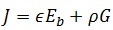
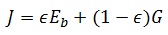
where,  is the emissivity and Eb is the blackbody emissive power. Because the transmissivity is zero due to opaque surface and absorptivity of the body (grey) will be equal to its emissivity by Kirchhoff’s law.

Thus, eq.7.24 becomes
|
(7.25) |
The net energy leaving the surface is the difference between the radiosity and the irradiance (fig.7.6a),
|
(7.26) |
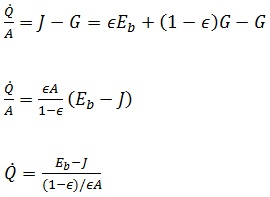
The eq.7.26 can be analogous to the electrical circuit as shown in fig.7.6(b). The numerator of the eq.7.26 is equivalent to the potential difference, denominator is equivalent to the surface resistance to radiative heat, and left part is equivalent to the current in the circuit.
In the above discussion we have considered only one surface. Now we will analyse the exchange of radiant energy by two surfaces, A1 and A2, as shown in the fig.7.7a.
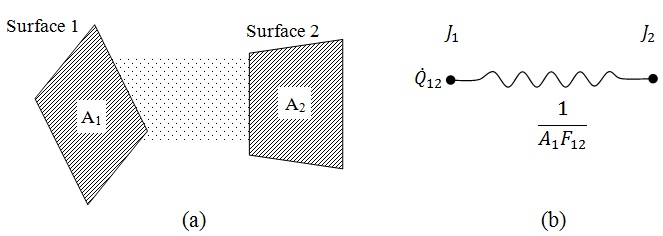
Fig. 7.7: (a) Energy exchange between two surfaces, (b) equivalent circuit diagram