Illustration 7.2
A pipe having 10 cm of diameter is carrying saturated steam at 8 bar of absolute pressure. The pipe runs through a room. The wall of the room is at 300 oK. A portion around 1 m of the pipe insulation is damaged and exposed to the room atmosphere. Calculate the net rate of heat loss from the pipe by radiation.
Solution 7.2
The emissivity of the pipe surface is not given so it may be considered black. Moreover, since the room may be big compared to the surface area of the pipe, the room may also be considered to be a blackbody.
We can write F11 + F12 = 1.
The value of F11 = 0, as the pipe cannot see itself.
Thus F12, the view factor (1-pipe, 2-room) will be 1.
The net rate heat loss due to radiation,

Tpipe can be obtained by the temperature of the steam at the prevailing pressure with the help of steam table = 450 K.
σ (= 5.67 X 10⁻⁸ W/m2/K4)
On putting the value,
Q12 = {π(0.1)(1)}(1)(1)(5.67 X 10⁻⁸){4504 - 3004}
Q12 = 586 W
7.5 Heat exchange between non blackbodies
Evaluation of radiative heat transfer between black surfaces is relatively easy because in case of blackbody all the radiant energy which strikes the surface is absorbed. However, finding view factor is slightly complex, but once it can be done, finding heat exchange between the black bodies is quite easy.
When non blackbodies are involved the heat transfer process becomes very complex because all the energy striking on to the surface does not get absorbed. A part of this striking energy reflected back to another heat transfer surface, and part may be reflected out from the system entirely. Now, one can imagine that this radiant energy can be reflected back and forth between the heat transfer surfaces many times.
In this section, we will assume that all surfaces are in the analysis are diffuse and uniform in temperature and that the reflective and emissive properties are constant over all surfaces.
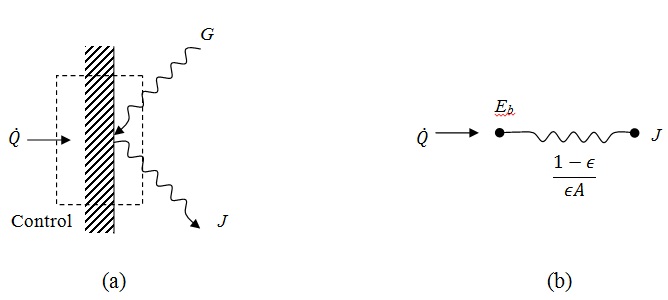
Fig. 7.6: (a) Surface energy balance for opaque surface (b) equivalent electrical circuit