The thermal conductivity of the liquid is represented by kl. The above rate of heat transfer is due to the latent heat of condensation of the vapour. Thus,
|
(6.8) |
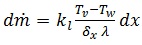
The specific latent heat of condensation is represented by λ. On solving eqs.6.7 and 6.8, for boundary layer conditions (x = 0; δx = 0)
|
(6.9) |
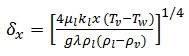
The eq. 6.9 gives the local condensate film thickness at any location x. If h is the film heat transfer coefficient for the condensate film, heat flux through the film at any location is,
|
(6.10a) |
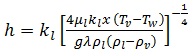
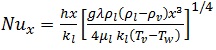
The local Nusselt number will be,
We can also calculate the average heat transfer coefficient along the length of the surface,
|
(6.10b) |

In eq. 6.10, the liquid properties can be taken at the mean film temperature  The equation 6.10 is applicable for Pr > 0.5 and
 ≤ 1.0
It can also be understood that at any location on the plate the liquid film temperature changes from Tv to Tw. It indicates that apart from latent heat some amount of sensible heat will also be removed. Thus, to take this into account and to further improve the accuracy of Nusselt’s equation (eq. 6.10), a modified latent heat term  can be used in place of λ. The term Ja is called the Jacob number as is defined by eq. 6.11. All the properties are to be evaluated at film temperature.
|
(6.11) |
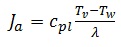
In the previous discussion we have not discussed about the ripples or turbulent condition of the condensate film as it grows while coming down from the vertical wall. The previous discussion was applicable only when the flow in the condensate film was 1-D and the velocity profile was half parabolic all along the length of the wall. However, if the rate of condensation is high or the height of the condensing wall is more, the thickness of the condensate film neither remains small nor the flow remains laminar.
The nature of the flow is determined by the film Reynolds number (Ref). The local average liquid velocity in the film can be obtained by eq. 6.6.
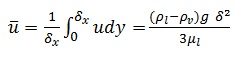
Now, the Ref can be calculated by,
|
(6.12) |
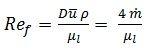
where D is the hydraulic diameter of the condensate film. The hydraulic diameter can be calculated by the flow area (δx.1) and wetted perimeter (unit breadth, thus 1). It has been found that, if