6.4 Film condensation on a vertical flat plate
Figure 6.4 shows a vertical wall very long in z-direction. The wall is exposed to a condensable vapour. The condensate film is assumed to be fully developed laminar flow with zero interfacial shear and constant liquid properties. It is also assumed that the vapour is saturated and the heat transfer through the condensate film occurs by condensation only and the temperature profile is assumed to be linear.
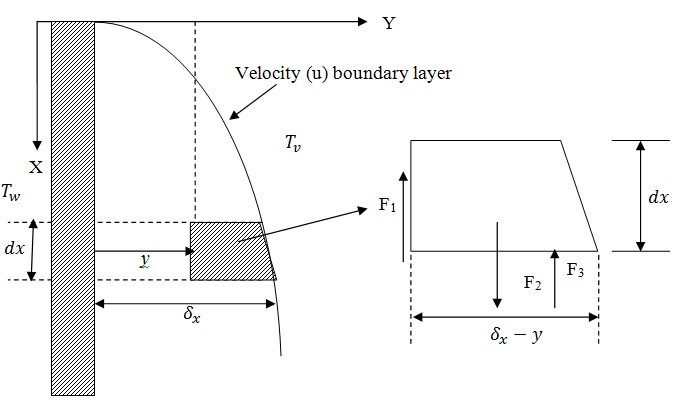
Fig. 6.4: Condensation of film in laminar flow
The wall temperature is maintained at temperature Tw and the vapour temperature at the edge of the film is the saturation temperature Tv. The condensate film thickness is represented by δx, a function of x. A fluid element of thickness dx was assumed with a unit width in the z-direction.
The force balance on the element provides,
F1 = F2 - F3
where, shear force 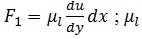 is the viscosity of the condensate (liquid). In the subsequent sections of this module, the subscripts l and v will represent liquid and vapour phase.
Gravity force, F2 = ρlg (δx - y)dx; and Buoyancy force, F3 = ρvg (δx - y)dx |
Thus,

On integrating for the following boundary condition, u = 0 at y = 0; no slip condition.
|
(6.6) |
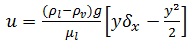
Equation 6.6 shows the velocity profile in the condensate falling film.
The corresponding mass flow rate of the condensate for dy thickness and unit width of the film,
|
(6.7) |
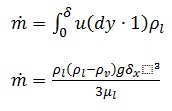
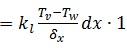
where dy is the length of the volume element at y distance. The rate of condensation for dx.1 (over element surface) area exposed to the vapour can be obtained from the rate of heat transfer through this area.
The rate of heat transfer