Heat transfer in boiling and condensation
In the previous chapter we have discussed about the convective heat transfer in which the homogeneous single phase system was considered. The heat transfer processes associated with the change of fluid phase have great importance in chemical process industries. In this chapter, we will focus our attention towards the phase change from liquid to vapour and vice-versa.
6.1 Heat transfer during boiling
The conversion of a liquid into a vapour is one of the important and obvious phenomena. It has been found that if water (say) is totally distilled and degassed so that it does not have any impurity or dissolved gases, it will undergo liquid to vapour phase change without the appearance of bubbles, when it is heated in a clean and smooth container. However, in normal situation, as can be understood, the presence of impurities, dissolved gases, and surface irregularities causes the appearance of vapour bubble on the heating surface, when the rate of heat input is significantly high.
The boiling may be in general of two types. The one in which the heating surface is submerged in a quiescent part of liquid, and the heat transfer occur by free convection and bubble agitation. The process is known as pool boiling. The pool boiling may further be divided into sub-cooled or local boiling and saturated or bulk boiling. If the temperature of the liquid is below the saturation temperature, the process is known as sub-cooled, or local, boiling. If the liquid is maintained at saturation temperature, the process is known as saturated or bulk boiling.
The other form of the boiling is known as forced convective boiling in which the boiling occurs simultaneously with fluid motion induced by externally imposed pressure difference. In this chapter, we will mostly consider the pool boiling.
As generally the bubbles are formed during boiling, we will first refresh the following basic information. Consider a spherical bubble of radius in a liquid as shown in fig. 6.1
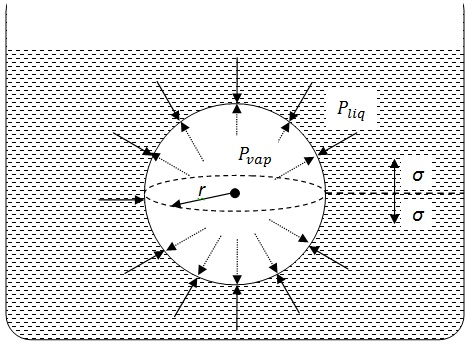
Fig. 6.1: Force balance on a submerge spherical bubble in a liquid
The pressure of vaporisation inside the bubble, Pvap, must exceed that in the surrounding liquid, Pliq, because of the surface tension (σ) acting on the liquid-vapour interface.
The force balance on the equatorial plane
πr2(Pvap - Pliq) = 2πrσ |
|
|
(6.1) |
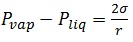
The eq. 6.1 shows that to create a bubble of small radius, it would be necessary to develop very large pressure in the vapour. In other word, a high degree super heat is necessary for the generation of a tiny bubble (or nucleus) in the bulk liquid. This is the reason, the bubble are usually formed at bits existing in the surface irregularities, where a bubble of finite initial radius may form, or where gasses dissolved in the system of the liquid come out of the solution.