It has been found over the years that the average Nusselt number (or the average heat transfer coefficient) for convective heat transfer can be represented by the following functional dependence (say viscous flow past a hard body).
Nu = f(Re,Gr,Ec,Pr) |
(5.1) |
The Reynolds number (Re) is the ratio of inertia forces in the fluid to the viscous forces. The Grashof number (Gr) is the ratio of buoyant forces to the viscous forces. The Eckert number (Ec) is a measure of the thermal equivalent of kinetic energy of the flow to the imposed temperature differences. The Eckert number arises due to the inclusion of viscous dissipation. Thus Ec is absent where dissipation is neglected. The Prandtl number, Pr, is the ratio of the momentum diffusivity (kinematic viscosity) to the thermal diffusivity. In other words, Prandtl number is a measure of the relative magnitude of the diffusion of momentum, through viscosity, and the diffusion of heat through conduction, in the fluid.
In case of perfect natural-convection and in absence of heat dissipation, the eq. 5.1 reduces to,
Nu = f(Gr,Pr) |
(5.2) |
It is to be noted that in case of perfect natural convection, the main fluid stream is absent, thus Reynolds number is no longer significant.
The dimensionless numbers involved in eq. 5.2 evaluated at the average film temperature,  It can be easily found that in case of the forced convection and in absence of heat dissipation the function for average heat transfer will be,
Nu = f(Re,Pr) |
(5.3) |
On comparing eq. 5.2 and 5.3, one can see that the Grashof number will perform for free convection in a same way as the Reynolds number for forced convection.
Another parameter, the Rayleigh number is also used for perfect natural-convection is defined as,
Ra = Gr . Pr |
(5.4) |
Thus the functional relation is eq. 5.2 can be written as,
Nu = f(Ra,Pr) |
(5.5) |
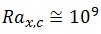
As discussed earlier that all free convection flows are not limited to laminar flow. If instability occurs, the problem becomes complex. A general rule one may expect that transition will occur for critical Rayleigh number of
|
(5.6) |
The Grashof number is defined as
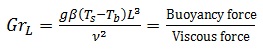
where,
| g = | acceleration due to gravity | |
| β = | coefficient of volume expansion =  |
|
| Ts = | surface temperature | |
| Tb = | bulk fluid temperature | |
| L = | characteristic lenght | |
| v = | Momentum diffusivity (kinematic viscosity) |