5.1 Introduction
In the previous chapter, we have discussed about the forced convective heat transfer when the fluid motion relative to the solid surface was caused by an external input of work by means of pump, fan, blower, stirrer, etc. However, in this chapter we will discuss about the natural or free convection. In natural convection, the fluid velocity far from the solid body will be zero. However, near the solid body there will be some fluid motion if the body is at a temperature different from that of the free fluid. In this situation there will be a density difference between the fluid near the solid surface and that far away from the system. There will be a positive or negative buoyancy force due to this density difference. Hot surface will create positive buoyancy force whereas the cold surface will create the negative buoyancy force. Therefore, buoyancy force will be the driving force which produce and maintain the free convective process. Figure 5.1 shows the natural convective process for a hot and cold vertical surface.
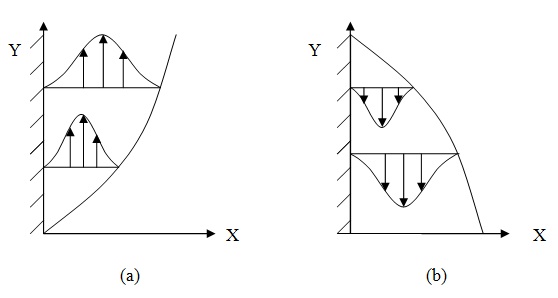
Fig.5.1: Free convection boundary layer for vertical (a) hot surface and (b) cold surface
Consider a vertical flat plate with contact of a fluid (say liquid) on one side of the plate. Now assume that we raise the temperature of the plate to Ts, a natural convective boundary layer forms as shown in fig. 5.2. The velocity profile in this boundary layer is slightly different as compared to forced convection boundary layer. At the wall the velocity is zero because of no slip condition. The velocity increases to maximum and then reduces to zero at the end of the boundary layer because the fluid is at rest in the bulk. Initially the laminar flow is achieved in the boundary layer, but at some distance from the leading edge, depending on the fluid properties and the temperature difference between plate and bulk fluid, turbulent eddies are found thus laminar to transition region comes. On further away from the leading edge the boundary layer may become turbulent and the boundary layer instability comes in to picture. Instability of the boundary layer is quite complex and does not fall into the scope of this study material.
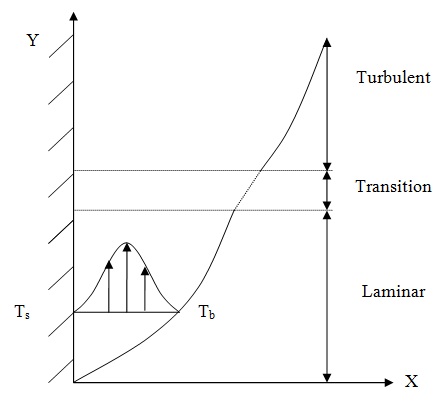
Fig. 5.2: Boundary layer on a hot vertical flat plate (Ts: surface temperature; Tb: bulk fluid temperature)